![MaritimeJournal[Seawork]](https://www.maritimejournal.com/wp-content/uploads/2026/09/MaritimeJournalSeawork.svg)




Electronic Inclinometer enhances tug safety
Tug capsizes and near-capsizes, particularly those caused by towline girting are an area that MJ still reports on all too often.
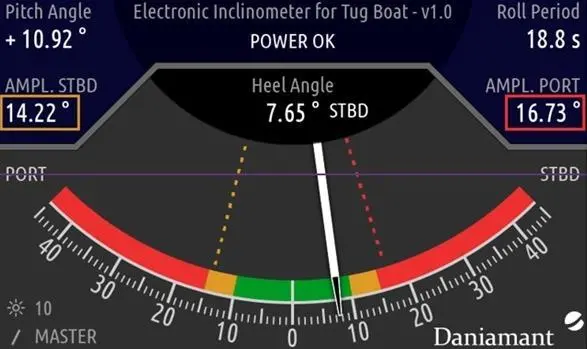
It’s good news all round then that Danish marine safety equipment manufacturer, Daniamant, has launched a tug version of its Electronic Inclinometer.
A heel and pitch measuring device, the DanEI-300T fulfils the most recent Bureau Veritas Group’s regulations for escort tugs and is approved by German BSH to the IMO (International Maritime Organisation) performance standard MSC.363(92):2013.
Bureau Veritas’ classification rules in the January 2019 edition stipulate that escort tugs must be equipped with a calibrated heeling angle measurement system, otherwise referred to as an inclinometer. This equipment must feature an adjustable audible and visible alarm which informs crews if the heeling angle or steady towline force exceeds permissible values applicable to the relevant loading conditions and escort speed.
The DanEI-300T’s sensor features an advanced gyro microelectromechanical system (MEMS) component, accelerometer MEMS component and a powerful microcontroller. Using complex algorithms, three rotation parameters (pitch, heel, yaw) and three acceleration parameters (surge, sway, heave) can be accurately calculated. This data is then sent from the sensor to the display unit, where it can be retrieved via serial or Ethernet interface, in standard NMEA (National Marine Electronics Association) format. The self-calibrating unit is easy to use and fit and can be installed by tugboat crews. As position to the tugboat’s centerline is calculated automatically, the sensor does not require a special location.
Daniamant developed the DanEI-300T’s user interface based on feedback from internationally-recognised Canadian high-performance tugboat naval architects, Robert Allan Ltd. Using a traffic light system, crews can easily see the heeling of the tugboat and will be promptly alerted to the level of response required to return the vessel to the safety of the green zone. A clear alarm will sound when the display changes from green to amber, signalling momentary heel and an imminent need for response. An additional alarm will be triggered when the display enters into the red zone, signalling the need to reduce the heel immediately as it has exceeded the safe limits of stability. The range of each zone can be entered and adjusted easily via the keypad on the front of the display.
The DanEI-300T measures the heeling angle of the vessel in real time, updating every 0.1 seconds to ensure data is collected continuously in the display unit. This ensures an immediate response can be taken to rectify a potentially dangerous situation and also means a maritime investigation authority can get detailed information on the sequence of events following an accident.
By Jake Frith
Related Articles
 ACCESSORIES & EQUIPMENT
 OTHER NEWS
 ACCESSORIES & EQUIPMENT