![MaritimeJournal[Seawork]](https://www.maritimejournal.com/wp-content/uploads/2026/09/MaritimeJournalSeawork.svg)




Evolution keeps pulling
“There’s no chance of standing still in this industry,” says Christian Herzog of the well-known Hatlapa brand, now part of the MacGregor Group.
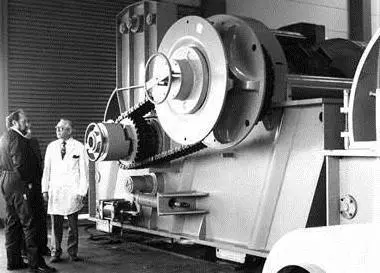
As he recently explained to Maritime Journal: “You can’t say, in our portfolio we have a 50 tonne winch, a 100 tonne winch, a 150 tonne winch and so on, and expect to stick with these designs forever.”
It’s been a long evolution and the 95 year old Hatlapa brand has been there from the beginning. “In the early days it was just a drum with a quantity of wire wrapped round it,” said Mr Hertzog. “Even I can remember towing winches with just 5 tonnes of pull and 5m/min of line speed; this has changed over the last decade and 100 tonnes of line pull with a 20m/min line speed requirement isn’t uncommon: we’ve now had a few projects which asked for 300 tonnes of pull.” Recently even that was made to look small; an order came in for a towing winch for a tug capable of also taking on some anchor handling work: this needed a capability of no less than 500 tonnes.
But it isn’t just power that’s become an issue: there’s weight, overall footprint and all kinds of additional features that have helped to drive the evolution. “To start with the company designed and cast all of its own gearboxes, it was useful because many of the parts were similar across the range. But then around 15 years ago the company saw that it could reduce the overall size of the winches by a quarter or a third just by buying planetary gearboxes from third-party suppliers.”
It wasn’t a straightforward path: the company’s first attempt at sourcing these very specialised gearboxes ran into trouble as the suppliers hadn’t worked with such hostile environments before; the high humidity salt water and large differences in ambient temperatures created issues, and in one case it was found that the gearbox was simply not up to long periods of high torque. Mr Herzog admitted: “You could call it ‘an interesting time’… Or something less diplomatic. However after a lot of work we found suppliers that could meet the specifications and now we are in a really good position.”
“Another initiator has been the escort notation from the class societies. Whereas a normal towing winch might have a nominal pull of say 50 tonnes with a brake holding capacity of 100 tonnes to 200 tonnes, when it comes to escort duty the winch brake isn’t engaged,” he explained. “So, keeping the line continually active on render-recover operations means having a very high pulling force coming through the drive.”
All this has resulted in developments such as Hatlapa’s low pressure hydraulic towing double drum winch. With a reverse waterfall configuration, it has capacity for 1,000m of Ø56 mm steel wire giving 95 tonnes of active pull up via an automatic tension control and spooling device. On the AHT Braveheart it was paired with an anchor handling drum.
Further, although the normal claw clutch gives a reliable and drive chain connection it lacks easy disconnection under high loads. However, because easy, quick release is an imperative for safety during towing operations, Hatlapa has a friction-locked clutch in its portfolio which releases more easily under load than the interlocking variety.
Materials have changed a lot since the early days too. A number of gearing elements used to be quite simply cast in mild steel but over the last decade this has been replaced by high-quality forged alloys which are often finished by case hardening and grinding.
“There are always different requirements,” said Mr Herzog. “If you get an initial request for quotation a 100 tonne towing winch, there’s a temptation to think, we’ve done this so many times before that it should not be any problem. But the deeper you look more you start to see that it needs a completely different treatment.”
For example a couple of years ago the company had to find a solution for a towing winch that had to be able to deal with a very fast line payout speed: “For this we started to incorporate a water-cooled brake, and in the end it was so successful it has now crossed over into our big offshore support projects.”
By Stevie Knight
Related Articles
 OTHER NEWS
 ACCESSORIES & EQUIPMENT
 ACCESSORIES & EQUIPMENT