![MaritimeJournal[Seawork]](https://www.maritimejournal.com/wp-content/uploads/2026/09/MaritimeJournalSeawork.svg)






Getting onboard a groundbreaking design
The design of the new passenger boarding bridges for the Kai Tak Terminal in Hong Kong is more than sophisticated to look at, “it’s also a been a very technically demanding project”, says the MD of Barcelona based Team, Jordi Floreta.
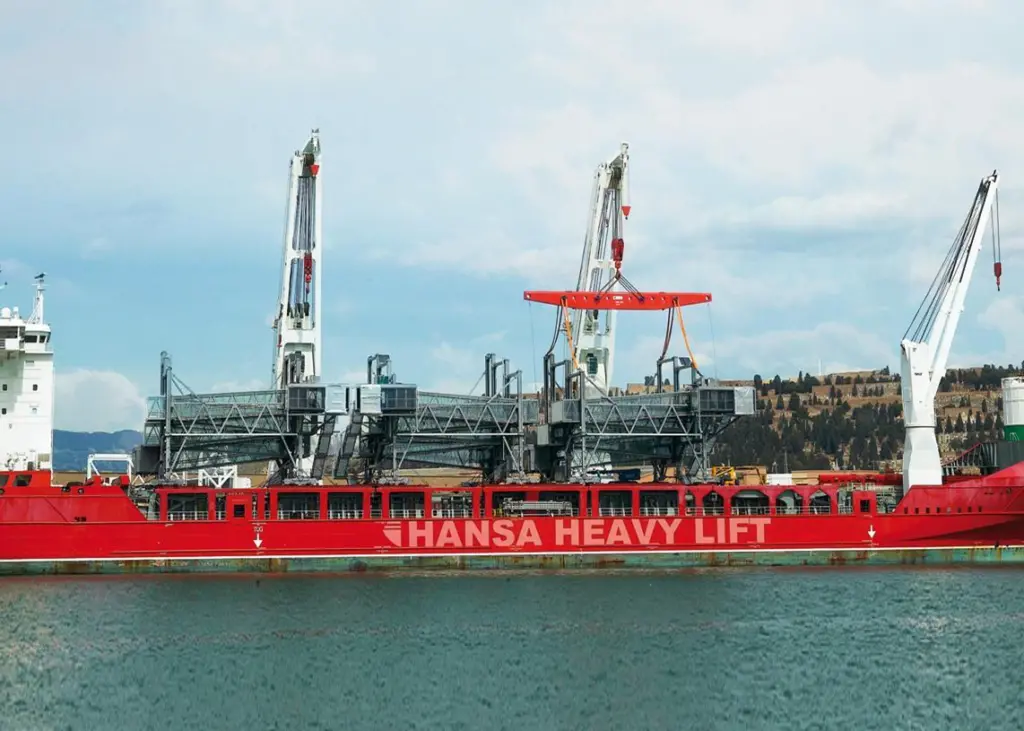
These are some of the largest and most modern Passenger Boarding Bridges (PBBs) built, “partly because they have to keep up with the evolution of the new generation of megaships calling into the port”, he tells MJ.
The issue is that each one of the PBBs has to allow docking from the biggest to the smallest cruise ships so the walkway gradient needs a lot of control, Mr Floreta explains. Each of the PBBs will have five enclosed tunnels with a maximum slope of 1:12. These ‘zig-zag’ upward in parallel to the side of the ship, with intermediate landings to ease the way, especially important for older or disabled passengers.
What may not be evident to the casual observer is that these PBBs are fully self-supporting units.
“It’s important that the load isn’t transferred either onto the ship or indeed onto the building, so the whole construction has to be suspended from four large legs with the whole thing on gantry rails to allow for positioning. Even the last telescoping ‘cabin’ section that has to extend around the lifeboats needs to be fully supported by the PBB structure,” he explains.
Across at the terminal entrance the first section also extends left or right to mate up with the terminal doorways, again independently supported by the PBB. Safety has to be completely guaranteed with cabins that perfectly match the vessel’s movements, immediately undocking in the event of an emergency.
Moreover, while it is useful that the quayside at the Kai Tak Terminal is around 35m wide, allowing room for these five-tunnelled bridges, there’s the complication that quayside traffic, automobiles and trucks, all have to be able to pass underneath undisturbed.
Therefore, although the ten electromechanical lifting systems are sophisticated, it doesn’t take too much to operate, as each automatically takes its cue from the total height input, adjusting the gradients independently.
To achieve a green design these PBBs also have solar panel lighting and, last but not least, because the Kai Tak terminal has been designed by prestigious architect Norman Foster, the PBBs have to follow suit, blending in with the sophisticated style of the main building.
So, although people may well look up at the light and elegant structure, not too many of them will be taking notice of the groundbreaking technology actually holding it up in the air.
Related Articles
 ACCESSORIES & EQUIPMENT
 ACCESSORIES & EQUIPMENT
 ACCESSORIES & EQUIPMENT