
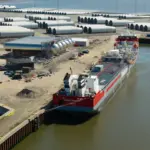

High-tech lightweight lines gain favour
Samson Rope Technologies have just fitted out a fleet of 11 tankers, each of 76,600 DWT, with synthetic mooring line, leading to increases in safety, savings and handling speed for BW Shipping Managers Pte.
The mooring line made by Samson uses DSM Dyneema’s super strong, high modulus polyethylene fiber, Dyneema, which is gaining ground as a popular material for mooring mid-sized tankers in the global petroleum market.
For many years, most mooring line was made of wire rope, which presented some significant safety challenges. Wire rope will snap back if it breaks and the snapback can cause serious injuries.
The first uses of high strength Dyneema fiber were the result of an urgent search for mooring lines that would be safer than conventional steel wire. More than a decade ago, Samson and DSM joined forces as partners developing high strength polyethylene lines. This collaboration resulted in today’s Samson AmSteel Blue Mooring Lines, the same product adopted by BW Shipping for its tanker fleet.
AmSteel Blue is the brand name for Samson’s premium non-jacketed mooring lines, made with Dyneema SK75 fiber. The result is a torquefree, 12strand braided rope which, size for size, has comparable strength to wire rope, but only 1/7th the weight. The blue color is created by a proprietary Samthane coating that enhances wear life and snag resistance.
The safety issue ranked highest with BW Shipping. ‘With ships of all types and sizes,’ says BW’s Captain Jones, ‘there is one common factor, the crew involved. We feel that we need to look at how we can make life both easier and safer for them when mooring. All feedback to date has been very positive and the crew can see the benefits of deploying AmSteel Blue ropes in terms of time saved and ease of handling. Based on our experience, I foresee a wide variety of ships, including oil and LNG tankers, switching to these lines.’
Samson lines are being used at giant floating production storage offloading vessels for lifting buoyed rigging attached to feeder lines. Tankers use them to connect to the floating FPSO reservoirs, and they are used as anchor lines for the FPSO vessels.
Related Articles
 ACCESSORIES & EQUIPMENT
 ACCESSORIES & EQUIPMENT
 OTHER NEWS