![MaritimeJournal[Seawork]](https://www.maritimejournal.com/wp-content/uploads/2026/09/MaritimeJournalSeawork.svg)



Innovative submarine rescue puts pressure on LARS
A new Submarine Launch and Recovery System (LARS) marks a milestone for offshore handling systems. It has been specifically designed for the fast rescue of distressed submariners in deep waters: “Given recent, tragic events,” Caley Ocean Systems told MJ “fast mobilisation timescales have never been more important.”
The announcement follows news that the Argentinian submarine which went missing in November with 44 on board may never be found.
The ‘flyaway’ rescue system from Scottish company JFD has a flexible architecture which means it can be mobilised within 24-hours. It can also be installed on a variety of vessels as well as moved between locations by air: all elements that shave down the critical time factor.
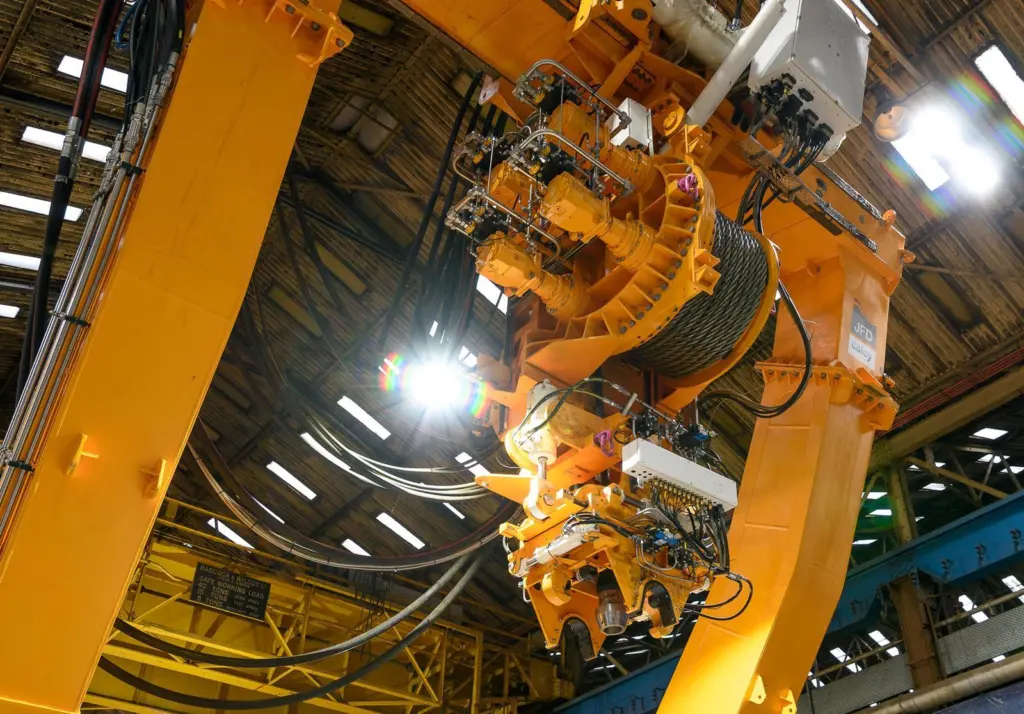
However, there’s quite a bit of sophistication to bringing the 33-tonne search and rescue module with its survivors safely to the diver decompression chambers (DDCs), so Caley, who designed the LARS, collaborated with Dana’s winch specialists to produce a solution capable of deployment in sea state 6.
The overall framework has two roles, it ties the unit to the vessel and also houses the three separate port, central and starboard DDCs.
At the rear, the large, 24.7m reach A-frame has a fully dampened swing beam with a gimballed traversing carriage. This runs back and forth along its crossbeam, aligning the sub with the appropriate chamber: the interface being provided by a Transfer Under Pressure (TUP) bridge. The A-frame also has a telescopic leg so the submarine can be safely raised and lowered to connect with the TUP despite rough weather.
Both Caley and Dana’s engineering teams worked together on the main winch of the LARS: the final configuration uses an internally geared slewing bearing driven by four of Dana’s industrial-series Brevini planetary gearboxes.
Richard Haskey of Dana explained the real advantage of having a one-stop-shop for both the gearing and the bearing. “There are an awful lot of variables that you can adjust on the loading of this winch: you have different levels of torque on operation and brake, but you can also adjust the teeth on both slew and pinions… the challenge is that one thing will impact another so it’s far better if you can go to a single manufacturer who can take responsibility for the whole thing.” He added: “It saves time, reduces risk, and makes everything easier – both for supply and for ongoing maintenance and servicing.”
Finally, he added that while the technology is well-proven, “everyone had to meet certain standards with regard to certification and so on, as it’s not just another ROV you are picking up, you have people inside to look after”.
The buyer for the first two complete JFD rescue systems is the Indian Navy, with a contract reportedly worth £193m.

Related Articles
 ACCESSORIES & EQUIPMENT
 OTHER NEWS
 ACCESSORIES & EQUIPMENT