![MaritimeJournal[Seawork]](https://www.maritimejournal.com/wp-content/uploads/2026/09/MaritimeJournalSeawork.svg)


Integrated Bridge System for polar vessel
Germany’s Raytheon Anschütz announced a recently awarded contract to supply their latest generation of Integrated Bridge System (IBS) to a new polar supply and research vessel at the SMM exhibition in Hamburg.
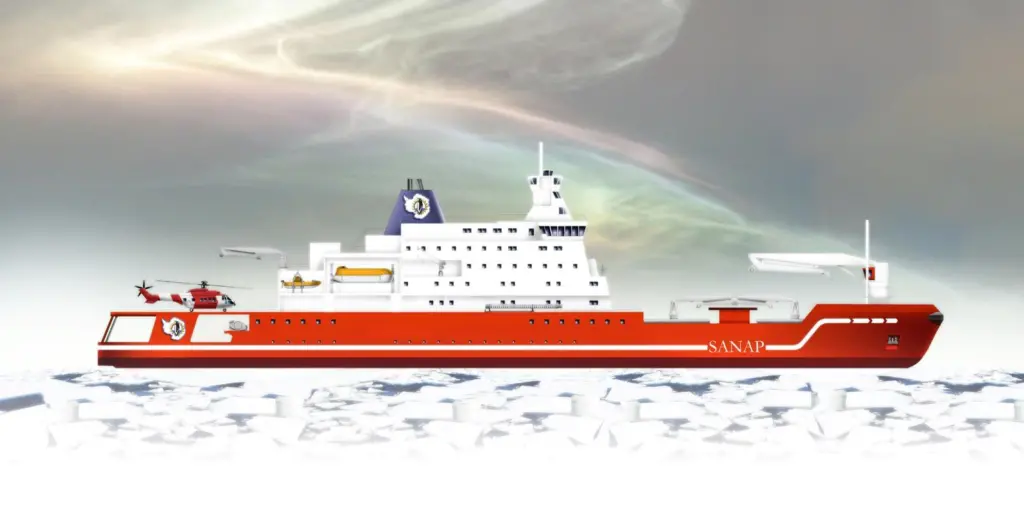
The vessel is being built at STX Finland shipyard in Rauma and will be owned by the Republic of South Africa’s Department of Environmental Affairs and Tourism (DEAT).
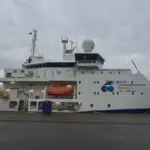
The 134m long vessel is intended to conduct research activities and expeditions to the polar region, but is also designed to serve as an icebreaker, a passenger ship or a supply ship for the South African research centres in the Antarctic.
Jörn Fischbach, manager for offshore and research vessels at Raytheon Anschütz said, ‘The vessel will be operated under most demanding conditions, thus the bridge equipment has to provide advanced functionality and has also has to be extremely reliable even when operating under harsh weather, sea and ice conditions.’
The new vessel will be equipped with a full integrated navigation system, which complies with DNV’s most demanding classification of NAUT-AW. Raytheon Anschütz will deliver a suite of six wide-screen workstations for navigation, which provide all the nautical functions of Radar, Chart Radar, ECDIS and Conning. The INS will also comprise the ship’s Dynamic Positioning (DP) System, which is integrated to share information such as waypoints with the navigation system. This is used for most precise operation within the ice fields, but the also for automatic heading keeping when berthing at an ice shelf or when taking bottom samples with the ship’s on board grabbing equipment.
One of the radars will be equipped as an Ice Radar with advanced ice imaging capabilities, which help to find the optimal route through icy waters and reduce fuel consumption and the risk of hull damage. The ECDIS will feature Autopilot Remote Control, which allows for autopilot operation while watching on the screen how the planned course fits into current traffic and the specific sea area. The economic autopilot Anschütz NP 2025 Plus is chosen to steer the ship automatically with the most precise track control of category C. Both bridge wings will be equipped with a chart radar, and also have the option for integrating the conning display for full navigation data indication during docking operations as well.
The helicopter console on the bridge will be equipped with an additional slave display of the chart radar and the SRTP Room will have independent installations of radar, GPS sensor and AIS in accordance with the ‘Safe Return to Port’ rules.
The IBS will be completed with the redundant gyro compass system Standard 22, the full package of navigation sensors, the navigation data management and the complete radio station according to GMDSS A4 for operation in the polar region.
The new polar supply and research vessel will replace the Agulhas, which is DEAT’s current expedition vessel. The delivery of the new ship is scheduled for 2012.
Raytheon Anschütz will supply the IBS at the end of 2011.
Related Articles
 ACCESSORIES & EQUIPMENT
 ACCESSORIES & EQUIPMENT
 ACCESSORIES & EQUIPMENT