![MaritimeJournal[Seawork]](https://www.maritimejournal.com/wp-content/uploads/2026/09/MaritimeJournalSeawork.svg)






Island installed at Rosyth on schedule
The recent lifting into place of the forward island marks a “highly visible achievement” in the build of the UK’s new Queen Elizabeth Class aircraft carriers says Babcock QEC project director Sean Donaldson.
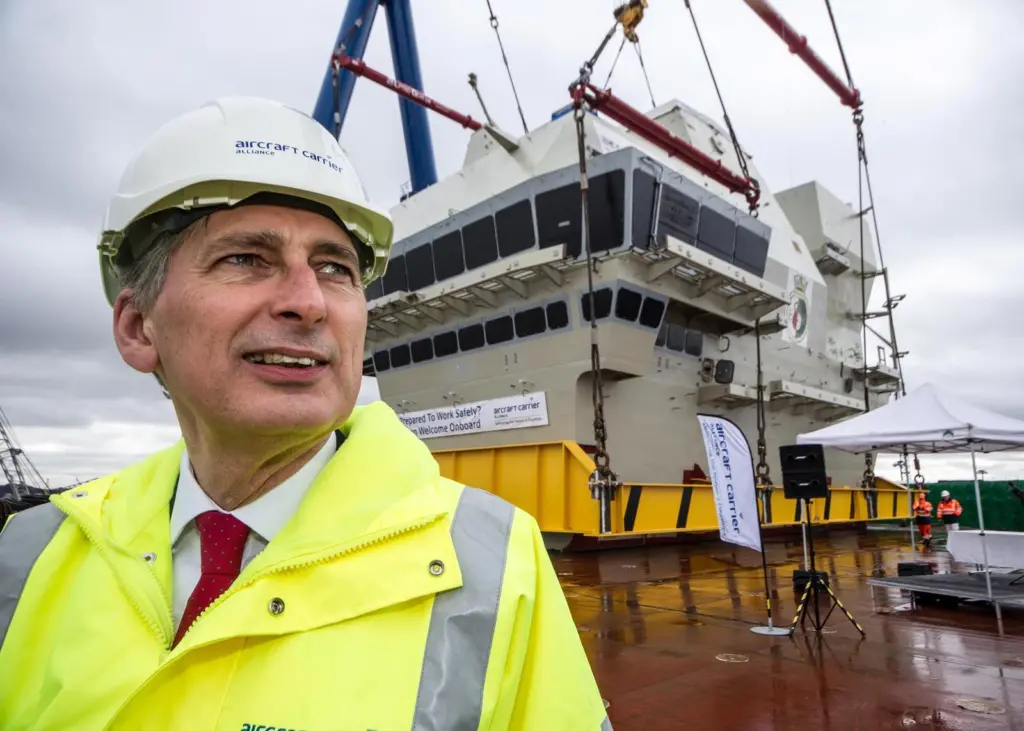
He adds that the timetable for this lift “was set over three years ago”, something of a surprise to those who hear a lot about schedules slipping.
The 27m by 22m and 13m high Upper Block 07 arrived at Babcock’s Rosyth facility from BAE Systems in Portsmouth in February. It weighs in at 600 tonnes and comes complete with all consoles installed, as well as 43km of cables and 3,101 pipes and 2m floor to ceiling main bridge windows.
Preparation included attaching a special 78 tonne lifting frame to Rosyth’s massive Goliath crane, while the main operation, watched by Secretary of State for Defence Phillip Hammond MP, began with the application of a percentage of the island weight to the crane to confirm the centre of gravity. This proved something of a challenge because the island’s geometry and shape don’t lend themselves to easy predictions. After some adjustments, the crane took the full weight of the island, lifted it over the aircraft carrier flight deck and located it in its final position. Then came the second set of challenges, alignment of the 2.4m diameter gas turbine exhausts which were pre-fitted in the island and below in the ship superstructure.
However, all went smoothly and with the island in place, radar installation and welding will follow along with mechanical and electrical system installation.
Its worth noting that this first island will not be alone as the QEC carriers will feature not one but two of these units, the second of which will mainly operate as an airport control tower to coordinate aircraft movements, although both are capable of switching roles.
Defence Secretary Philip Hammond points out that the addition of the forward island is a “significant milestone for HMS Queen Elizabeth” and adds that this class of Carriers will be in service for up to 50 years. This, the first of two carriers, will be structurally complete at the end of this year, with the ship capable of ‘float up’ in spring next year.
Related Articles
 ACCESSORIES & EQUIPMENT
 ACCESSORIES & EQUIPMENT
 ACCESSORIES & EQUIPMENT