![MaritimeJournal[Seawork]](https://www.maritimejournal.com/wp-content/uploads/2026/09/MaritimeJournalSeawork.svg)






Motion compensation platforms lifting off
A new era in offshore working has begun, with the launch of Barge Master.
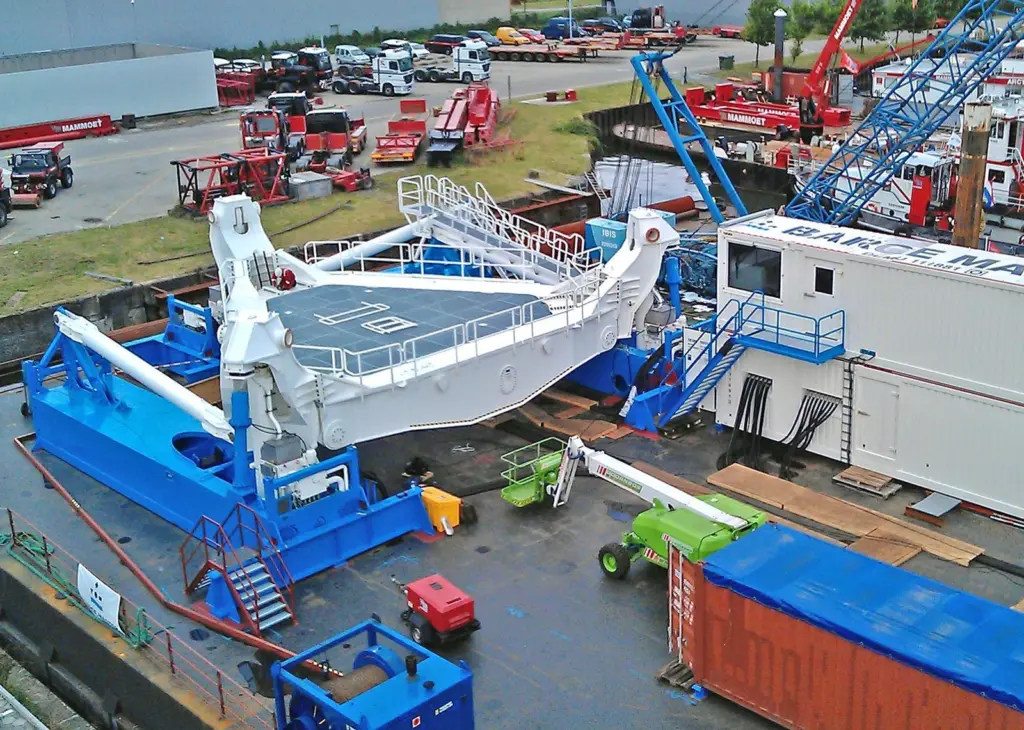
Motion compensation platforms to be used on board flat top barges and supply vessels, Barge Masters provide a stable base for cargo during vessel to platform transfers. They can also be used as a steady foundation for crawler crane lifting operations.
Designed as a low cost, high performance alternative to existing offshore and nearshore lifting equipment, such as jack-up barges, Barge Master has an internal hydraulic mechanism that measures wave and swell conditions and compensates for them so that the platform remains steady. With massive and unrelenting forces involved, a critical part of the system is the hydraulic power pack, which is driven by marine approved electric motors supplied by Rotor BV.
Barge Master has recently built its first platform with a 700 tonne load capacity. The hydraulic pumps of this platform are powered by three 510kW Rotor electric motors. The design of each new Barge Master can be easily customised to specific requirements if necessary.
In the moving three dimensional world of the sea, six degrees of freedom need to be compensated in order to keep the Barge Master platform from moving. Three degrees of freedom are compensated by restraining two translations (Surge and Sway) and one rotation (Yaw) of a barge or vessel by using traditional anchors or a dynamic positioning system.
The remaining three degrees of freedom, one translation (heave) and two rotations (roll and pitch), are compensated by the Barge Master and its three hydraulic actuators. By controlling the actuators, which produce the counteractive motion, and measuring the heave, roll and pitch, the platform is kept in an earth fixed steady position.
The control system is based on the concept of servo feedback loops. The hydraulic system is able to measure the beginnings of a sea-induced movement and generate a reverse thrust to compensate for it; the larger the motion, the greater the compensatory reverse thrust.
Maritime operations are always challenging, and as a result can be expensive, with deteriorating sea or weather conditions often bringing work to a standstill. However Barge Master increases workable conditions, helping contain cost and allowing deadlines to be met. It reduces dependence on high cost specialist equipment such as jack-up barges by allowing standard floating barges, vessels and cranes to be used more widely. The safety of personnel is also significantly improved.
In use, Barge Master has to provide a very stable working platform. Relatively small rotations of a barge (say 2-3 degrees) on which a crawler crane is placed could result in large movements (4-5m) of the crane boom tip and, therefore, the hook and load. These movements, relative to the land or an independently moving second barge, make working safely practically impossible. Barge Master is so sensitive that it can fully compensate for such movements.
Related Articles
 ACCESSORIES & EQUIPMENT
 ACCESSORIES & EQUIPMENT
 ACCESSORIES & EQUIPMENT