![MaritimeJournal[Seawork]](https://www.maritimejournal.com/wp-content/uploads/2026/09/MaritimeJournalSeawork.svg)






Moving the kit below
With the development of fast and light workboats there’s been a need for windlass equipment that avoids impacting operations or the hull’s action in the water.
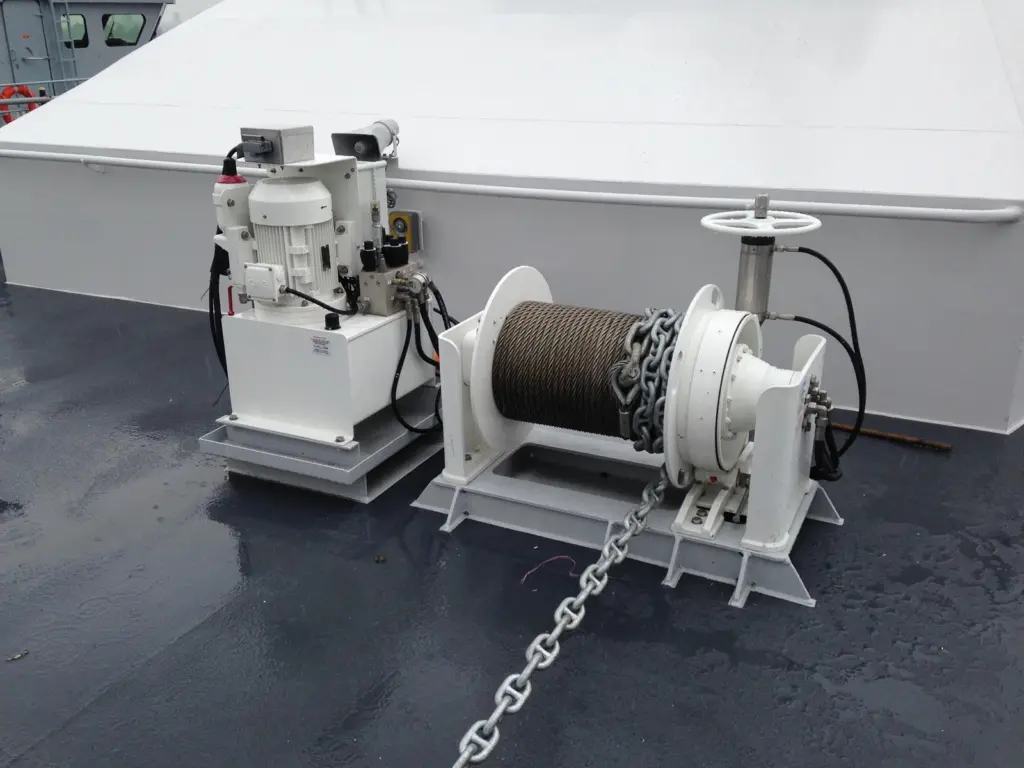
Jon Whetter of Seaway Powell Marine (sister company and distributor of Hypac deck equipment) explains that while GRP and aluminium workboats need to be aware of weight distribution, buoyancy-critical SWATH hulls in particular “need to keep an eye on the where the weight is distributed to ensure the most efficient design”. He adds that high speed vessel decks are also increasingly being used for equipment storage or working areas and so have to be kept clear of obstructions.
So, the development of a lightweight, fully-automatic anchor windlass like Hypac’s is particularly useful “as it can be located under the deck and out of the way, and you don’t need someone standing beside it to operate the brake” says Mr Whetter. He adds that the compact design allows it to fit into smaller compartments where the need for crew access to the windlass is very limited and conveniently, the powerpack can be mounted integral to the windlass or in a remote location. The windlass itself can also be oriented in a number of planes to give the most appropriate place for the available structure, including vertically on the inside of the hull or even inverted on the underside of the deck.
Mr Whetter says: “It really helps not just with weight distribution, but also with workboat’s general need for a clear foredeck around containers or project equipment. As the windlass can be monitored and operated entirely from the wheel house it’s useful for vessels where icy decks and rough weather or even very hot conditions could potentially create safety issues.”
It rests on some fairly clever engineering and it’s worth noting that no ‘devil’s claw’ is required to secure the anchor as it has separate brake, operated by a hydraulic cylinder. The system is protected by a charged accumulator that activates in case of failure.
The windlass’ dual speed includes a fast haul in to get the anchor raised quickly and a creep speed for anchor stowage to help protect the hull, plus a free-running drop for extra safety. Usefully, in addition to bridge or control station it also has an additional pendant to run the windlass from the deck.
By Stevie Knight
Related Articles
 ACCESSORIES & EQUIPMENT
 ACCESSORIES & EQUIPMENT
 ACCESSORIES & EQUIPMENT