![MaritimeJournal[Seawork]](https://www.maritimejournal.com/wp-content/uploads/2026/09/MaritimeJournalSeawork.svg)




New AIS transponder for boat owners
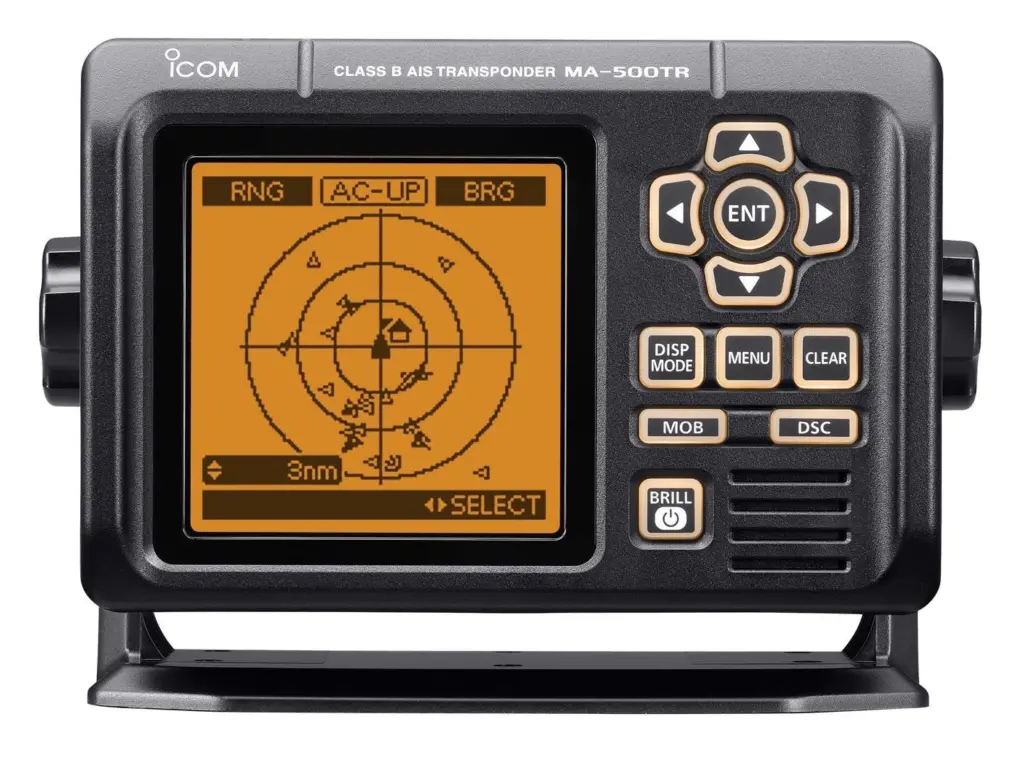
Navcomms specialist Icom UK Ltd is introducing a new AIS transponder, the MA-500TR, which will help owners of small craft to benefit from the latest safety technology.
Since its introduction, AIS (Automatic Identification System) has been rapidly taken up as an essential safety aid, especially as shipping lanes have become busier. Primarily used by commercial shipping for identification and location, the AIS system exchanges information such as MMSI number, position, course, and speed.
Ian Lockyer at Icom UK Ltd said, ‘The MA-500TR does what it says on the tin. It’s compact, easy to use and its clear dot matrix display means that it is easy to view other vessel traffic and information. It is the ideal transponder/receiver for any vessel owner who wants to make a more informed navigational decision when out at sea. The unit can be integrated with either Icom’s IC-M505 or IC-M603, allowing users to make an individual DSC call instantly from the MA-500TR.’
The Icom MA-500TR is a compact, waterproof Class B AIS Transponder. It has a dual channel receiver allowing boat owners to receive AIS information (both Class A and Class B AIS signals) on two channels simultaneously. This real-time information is then displayed on its large, backlit full dot matrix display giving the user real-time vessel traffic information, thus aiding navigation and collision avoidance.
The MA-500TR’s compact size means that it can for example be installed in a convenient place near the chart table, in the wheelhouse, on the fly bridge or on a pedestal in the cockpit. It features large, easy to use, backlit buttons that makes it easy to operate even in tough conditions. It uses the NMEA 0183 format for easy connectivity to most radars, chart plotters, and navigation systems.
The MA-500TR has several collision risk management functions. It identifies a target list of vessels in a local area, an alert list of potential collisions and what the closest point of approach is. A collision alarm and external alarm connection to optional external audio equipment gives the vessel owner extra warning of potential impact.
Related Articles
 ACCESSORIES & EQUIPMENT
 ACCESSORIES & EQUIPMENT
 ACCESSORIES & EQUIPMENT