![MaritimeJournal[Seawork]](https://www.maritimejournal.com/wp-content/uploads/2026/09/MaritimeJournalSeawork.svg)





New torpedo lifeboat hits the waves
It started with disaster in 1981. The failure of evacuation procedures on Alexander Kielland rig in the North Sea cost 123 lives, but that incident has helped to drive Norwegian safety innovation forward for almost three decades since.
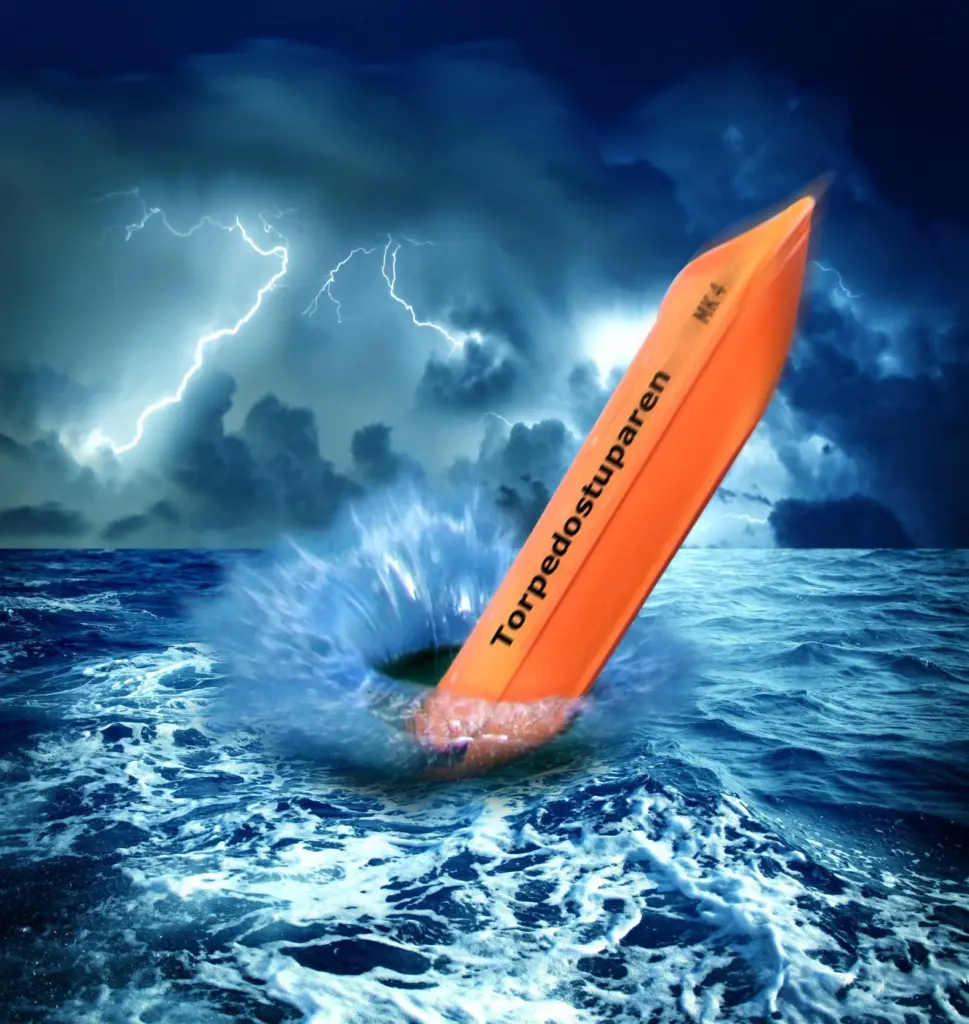
Thus a few months ago, when Norwegian Magnar Reigstad approached Noreq AS with a substantially new design of lifeboat that had already had won innovation awards. Noreq started a programme to see if the company could make his design, named the ‘Torpedo’, a reality.
Noreq has recently completed 1/12 scale tests in the Norwegian Marine Technology Research Institute (MarinTek), and, as Sveinung Pile, Noreq’s technical manager tells MJ, ‘The results were far better than we dared to believe. We have no doubt about the workability of the concept.’
Noreq completed 440 drops on the model, and the results are interesting. One of the biggest problems that lifeboats evacuating in extreme conditions face is simply putting some distance between themselves and the problem. ‘Standard lifeboats only give you around 40m distance from the platform, which in hurricane winds can result in smashing back into the ship or rig if you are unlucky. The new Torpedo lifeboat is propelled further under the surface and would give you more than 100m distance,’ explains Mr Pile.
The second problem that the new torpedo design overcomes is the problems of ‘jar’ or deceleration of human bodies when the lifeboat hits the water.
‘This is not a simple thing to calculate, because the forces acting on the spine are on all three axis,’ said Mr Pile. Recent tests on standard design lifeboats showed severe impact problems for personnel inside, and a huge push to modify existing lifeboats got underway. As a result, there are new DNV standards being put in place, and the rule is that the forces on the passengers have to come to less than 1.0 CAR (measured as an index of the normalised x, y and z accelerations together).
Under this new set of standards, the new torpedo design performs well within the margins. ‘440 test drops gave us scaled up results of between 0.5 and 0.7 CAR,’ said Mr Pile.
Related Articles
 ACCESSORIES & EQUIPMENT
 ACCESSORIES & EQUIPMENT
 ACCESSORIES & EQUIPMENT