![MaritimeJournal[Seawork]](https://www.maritimejournal.com/wp-content/uploads/2026/09/MaritimeJournalSeawork.svg)





Offloading the hard way
Co-operation – and improvisation – were the keys to getting a dredger off a ship where there was little infrastructure in place the other end.
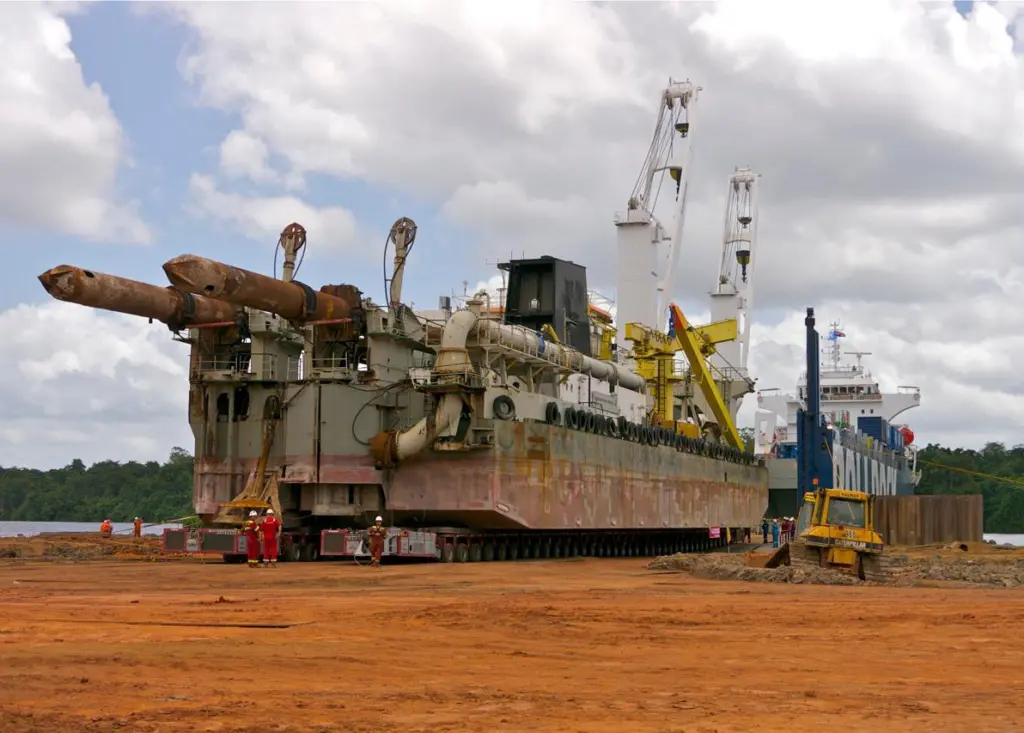
The issue facing Rolldock Sea, which had loaded an 83m, 2,100 tonne dredger in Abu Dhabi for a Dutch dredging company, was that the vessel was not just to be shrugged off into the water but transferred to landside transport for a further trek across Suriname’s jungle.
Jan Stuive, technical superintendent for the lift, explains the issues. “It was a challenging operation, the RD Sea firstly had to make its way 60km up a tidal river that winds like a snake, with very variable depths and flow. Then we had to find a way to deliver the dredger into a place that didn’t originally even have a suitable hard landing.”
He says that it meant taking measurements well in advance, which showed a fast running current and a tidal range that varied by over 2.8m at the only possible discharging site at Paranam. This also proved to be the site of a local aluminium factory: while the plant’s bulk quay couldn’t be used as it was far too high, it added to the challenges as beyond the tide and weather there was also shipping to accommodate.
The groundwork at the far end had been taking place for months before the ship arrived with the dredger onboard. A rudimentary quay from sheet piling backfilled with packed earth had been made in order to put some kind of hard edge underneath the offloading ramp – especially necessary as everything was turning into mud under “almost unbelievable torrents of rain”.
However, the action of the fast flowing current was still a concern, after all, the question was how to manoeuvre and moor a ship perpendicular to the flow and have it floating there for not just a couple of hours, but a whole day without it moving.
The ship’s own anchors and mooring lines could not, obviously, be relied on to keep the whole vessel stationary during the discharge, for one thing there wasn’t enough room to lay the anchors out across the river. “They ended up in some bushes,” admits Mr Stuive. Therefore a prelaid anchor system had been put in place by a set of small handling vessels. Still even this wasn’t quite enough to be certain that the ship wouldn’t move, so the landing quay was adapted to secure the aft of the vessel between two projections.
The challenges were considered steep enough that the operation went through a whole dry run three days before the actual discharge: that is if you can call something so wet a ‘dry run’, after all, it had been raining in torrents for days. “Everything was soaking and slippery, so extra work was needed to resurface the quay with grit to provide extra grip just the day before,” explains Mr Stuive.
But in the end the whole operation went off without a fuss or a hiccup. Onboard the RD Sea, the dredger was nestled on 1.2m high supports so the SPMTs rolled onto the deck underneath it, lifted up and then rolled off, taking the dredger with them.
“It took months of preparation, then in four or five hours it was all finished. Everyone took a deep breath of relief on our side, but then for the other team that had to negotiate the overland section it was really just starting,” points out Mr Stuive.
However, the dredger made it across the jungle: it seems its debut into Lake Blommestein Meer’s water was carried out in equally innovative fashion, the vessel was driven into a dugout next to the lake and then the earth between the two was simply torn down, allowing it to flood and raising the vessel in its own little harbour.
By Stevie Knight
Related Articles
 ACCESSORIES & EQUIPMENT
 ACCESSORIES & EQUIPMENT
 ACCESSORIES & EQUIPMENT