![MaritimeJournal[Seawork]](https://www.maritimejournal.com/wp-content/uploads/2026/09/MaritimeJournalSeawork.svg)






Report advises on vessel battery safety
A new report on battery safety in ships assesses explosion and fire risks in maritime battery installations and the effectiveness of fire extinguishing systems in the event of a battery fire.
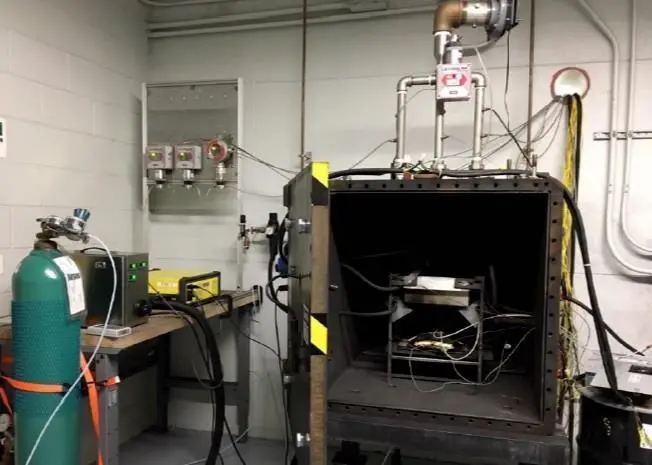
DNV GL’s report presents the results of research on what happens during a fire in a battery compartment, the release of gases, and the usefulness of various extinguishing systems in combatting the fire and preventing explosions.
One of the most important findings concerns ventilation systems, which are critical to avoiding an accumulation of explosive gas. The report concludes that ventilation alone will not adequately mitigate gas accumulation if a significant portion of the battery system ignites.
Preventative safety barriers
“In addition to fire suppression and ventilation, the battery design must have preventative safety barriers so that the fire and gas emissions are limited to as small a part of the battery system as possible,” said Henrik Helgesen, project manager for the research project and senior consultant at DNV GL.
The report provides new recommendations on ventilation systems, based on a newly created model which identifies the appropriate size and type of ventilation system based on a vessel’s battery installation.
Early fire and gas detection are also essential, meaning that the gas sensor should be located as close to the battery as possible.
The report was put together in collaboration with the Norwegian, Danish and US maritime authorities, battery manufacturers, system integrators, suppliers of fire extinguishing systems, shipyards and shipowners.
By Rebecca Jeffrey

Related Articles
 ACCESSORIES & EQUIPMENT
 OTHER NEWS
 ACCESSORIES & EQUIPMENT