![MaritimeJournal[Seawork]](https://www.maritimejournal.com/wp-content/uploads/2026/09/MaritimeJournalSeawork.svg)




Research highlights North Sea safety concerns
An EU part-funded project suggests e-Navigation technologies and services will be crucial for offshore wind turbines, oil/gas platforms, and shipping traffic to co-exist safely in the North Sea Region.
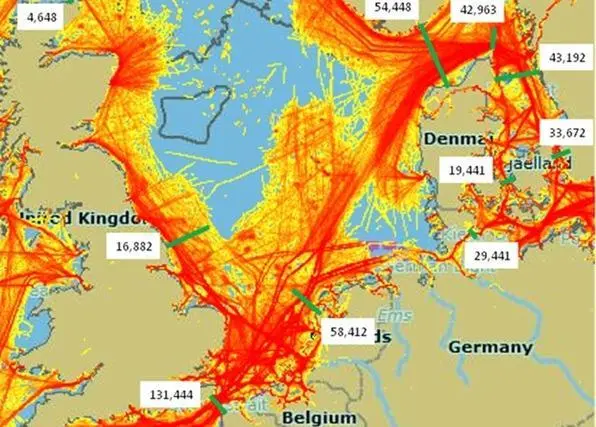
New research revealed on Tuesday by ACCSEAS Accessibility for Shipping, Efficiency Advantages and Sustainability (ACCSEAS) predicts significant safety concerns over excessive demands on the North Sea’s marine areas, which currently hosts some of the busiest shipping lanes in the world.
Based on expectations about the impact of areas of open sea being allocated for energy extraction (such as wind farms), ACCSEAS’ research, which is part-funded by the European Union, suggests that the North Sea Region’s navigable space will be reduced. The research indicates that navigable space allocated to wind farms could increase by up to 5,240% within just a few years, from the current c.440km² up to c.23,500km². This would constitute c.5.5% of all navigable space in the region, with a further 860km² (0.1%) taken up by exclusion zones around oil and gas platforms. Crucially, the precise location of many planned and proposed wind farm sites means that they could have a significant impact on key shipping lanes in the North Sea Region.
According to ACCSEAS, the size and location of such sites, coupled with projected increases in shipping traffic and vessel size, poses serious safety and efficiency concerns.
ACCSEAS is an EU part-funded project involving 11 partners from across the North Sea Region. Its aim is to research the extent of these issues and to develop and demonstrate e-Navigation technology solutions and potential service provisions that will be crucial to ensuring future maritime safety and accessibility in the North Sea. It uses a Geographic Information System to assess maritime traffic trends and the issues that obstruct available safe access.
E-Navigation is an initiative mandated by the International Maritime Organisation (IMO) to harmonise and enhance navigation systems by electronic means. These e-Navigation technologies are being developed to facilitate the collection, integration, exchange, presentation and analysis of maritime information onboard and ashore, for safety and security at sea and the protection of the marine environment.
Alwyn Williams, ACCSEAS project manager said: “Renewable energy deployments such as the wind farms proposed in the North Sea Region will play a crucial role in reducing carbon emissions and decreasing the dependency on nuclear energy, but they could also pose a significant threat to maritime safety as shipping traffic continues to grow. The shipping community wholeheartedly supports the renewable energy agenda, and we believe that e-Navigation technologies have the potential to reduce these risks through safer, more accurate navigation in order for turbines, other offshore obstacles, and ships to co-exist safely in the North Sea Region.”
This latest research will set the agenda at the forthcoming ACCSEAS Annual Conference at the Flensburg University of Applied Sciences in Germany on 5-7 March, which includes transnational stakeholders from the UK and Ireland, the Netherlands, Denmark, Sweden, Germany and Norway. It is hoped that the event, which includes a series of collaborative workshops, will produce tangible outcomes for identifying and developing solutions to address the concerns of all stakeholders. Participation in the ACCSEAS Annual Conference is open and free of charge.
ACCSEAS will be demonstrating a prototype resilient Positioning, Navigation & Timing (PNT) system, integrated into the bridge of a vessel for the first time in trials running this weekat Harwich, UK. The purpose of this demonstration is to highlight GPS vulnerability and show the benefit of having a resilient PNT solution in mitigating against GPS service denial.
Further information is available from www.accseas.eu
Related Articles
 ACCESSORIES & EQUIPMENT
 ACCESSORIES & EQUIPMENT
 ACCESSORIES & EQUIPMENT