![MaritimeJournal[Seawork]](https://www.maritimejournal.com/wp-content/uploads/2026/09/MaritimeJournalSeawork.svg)






Rope luffing knuckle boom crane
Huisman, the Netherlands’ specialist in lifting, drilling, and subsea solutions, has introduced a new rope luffing knuckle boom crane to better provide for subsea installation in increasingly deeper water and in severe weather conditions.
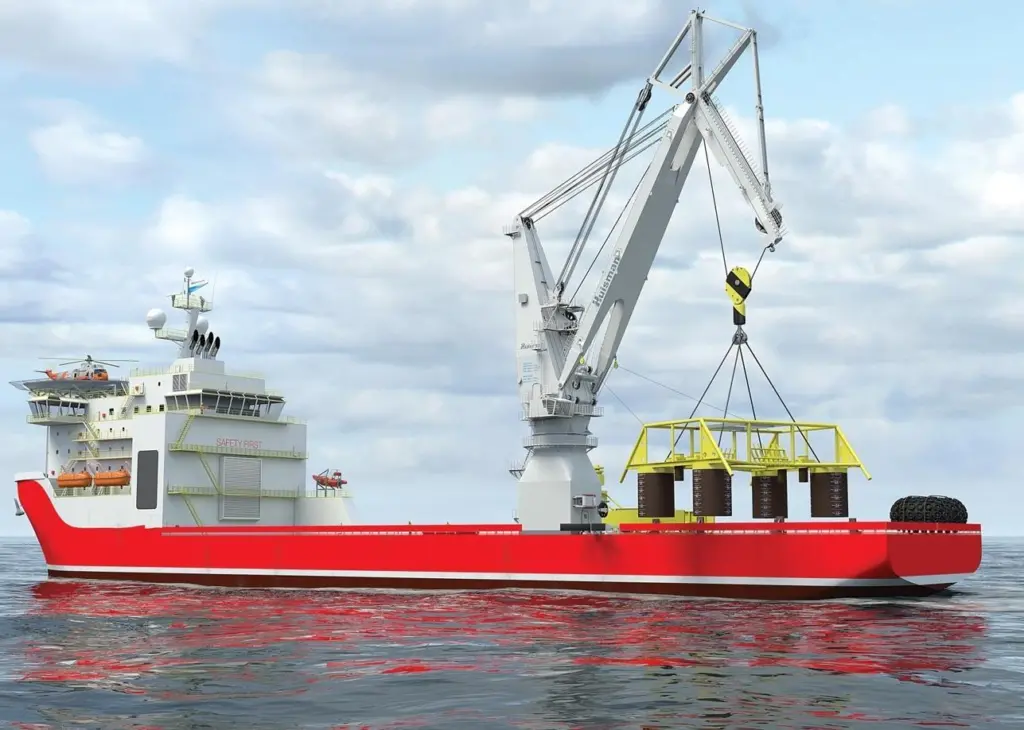
These new active heave compensated (AHC) cranes provide the benefits of a normal rope luffing crane and a traditional knuckle boom crane. Capacities of the new cranes range from 400 up to 1,200 tonne and up to 5,000m water depth.
All of this means that the overall construction weight of the crane can be kept low, whilst allowing for a high lifting capacity and large lifting radius. By incorporating a knuckle in the design of the crane it is possible to reduce the pendulum of the hook and, if extended, it can allow for high lifting heights.
Furthermore, the boom of the crane can be stored vertically saving valuable deck space. The main hoisting system comprises a traction and storage winch system and a separate heave compensation system. This means both lifting/lowering and heave compensation can occur simultaneously with no performance interdependency, resulting in a better overall system performance and increased safety. A failure in main hoisting system will not affect the heave compensator or the other way around.
Because the crane is fully electrically driven, the power consumption, noise levels, and the number of components are reduced. It also means that maintenance and operational costs are reduced.
The main hoist system can be equipped with a double fall reeve system instead of a single fall reeve system, improving the life span of the wire and therewith reducing operational expenditure. Further, the lifetime of the wire rope is significantly extended by the combined active and passive heave compensation system on the main hoist, since the number of sheave bends is minimised and there is no drum crushing or wire rope cut-ins on the winch.
In terms of safety, the anti-twist device prevents twisting of the lower block and wire rope during subsea lifts in double fall configuration. In addition, it lowers the point of application of the wire rope, which improves the stability of the vessel and reduces the boom tip motion.
The first crane of this type, a 900 tonne rope luffing knuckle boom crane for Subsea 7’s Seven Arctic, is scheduled for delivery in 2016.
By Anne-Marie Causer
Related Articles
 ACCESSORIES & EQUIPMENT
 ACCESSORIES & EQUIPMENT
 ACCESSORIES & EQUIPMENT