![MaritimeJournal[Seawork]](https://www.maritimejournal.com/wp-content/uploads/2026/09/MaritimeJournalSeawork.svg)

Rugged wind farm slings a success story
The first very large diameter synthetic rope sling certified by Lloyd’s for offshore installations is in use by Seaway Heavy Lifting (SHL) on the largest wind farm currently under construction.
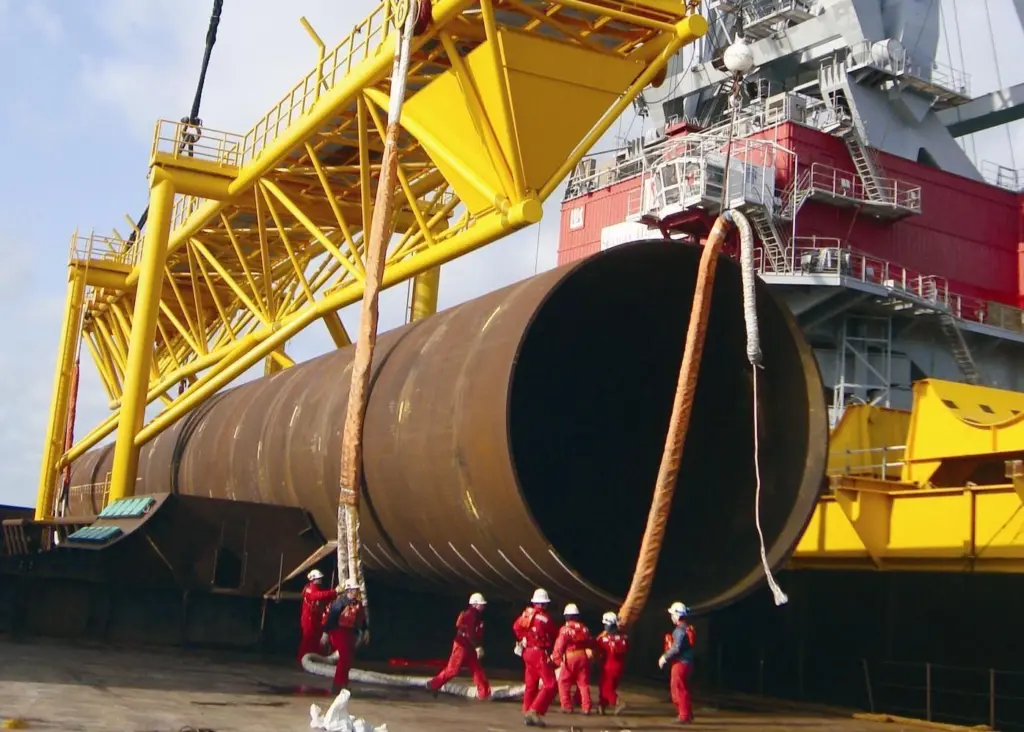
Two lifting systems, made from 144mm diameter rope manufactured by Samson, are currently assisting in the installation of 140 turbine foundation monopiles as a part of the North Sea’s Greater Gabbard offshore wind frm project.
SHL anticipated that synthetic slings would reduce potential damage to the monopiles during their transfer from the supply barge to the deck of the installation vessel in rough seas. Each monopile weighs from 519 to 676 metric tons. SHL chose to use braided rope slings over traditional woven round slings because strengths of up to 4,457 metric tons could be achieved and, because these slings have a removable jacket, they are easy to inspect, repair, and splice on site. Another factor in SHL’s decision to use rope slings was that they could be fabricated in longer continuous lengths than round slings.
The very large diameter polyethylene fibre rope was manufactured at Samson’s Louisiana USA plant. Subsequent break testing confirmed that the rope exceeded the strengths required for the job. The rope itself is of a 12 strand single braid construction with a UV resistant coating. Size for size, it has the same strength as steel and posses a low stretch factor, similar to wire, which it is designed to replace and outlast. It is torque free and easily spliced in the field if necessary.
The slings and grommets were fabricated by Endenberg, with all weight bearing points protected by chafe gear. Upon delivery, these became the first very large diameter synthetic rope slings certified by Lloyd’s for multiple uses in offshore installations.
Endenberg’s master splicer, who has conducted two inspections of the slings, said that no wear was shown on the first of the lifting systems even though almost half of the 140 turbine foundation monopiles had been installed. These inspections included removing the jacket and closely examining the entire line for wear and damage. Lloyd’s also proof loaded the line and re-certified it for continued use.
Because of this, it was decided that the original set of slings could be used for the remainder of the installations, with the second set held as backup.
Related Articles
 ACCESSORIES & EQUIPMENT
 ACCESSORIES & EQUIPMENT
 ACCESSORIES & EQUIPMENT