![MaritimeJournal[Seawork]](https://www.maritimejournal.com/wp-content/uploads/2026/09/MaritimeJournalSeawork.svg)



Simulating Schottel
German propulsion specialist Schottel has invested in a training simulator so that customers can now exercise their handling and knowledge of the company’s products and systems.
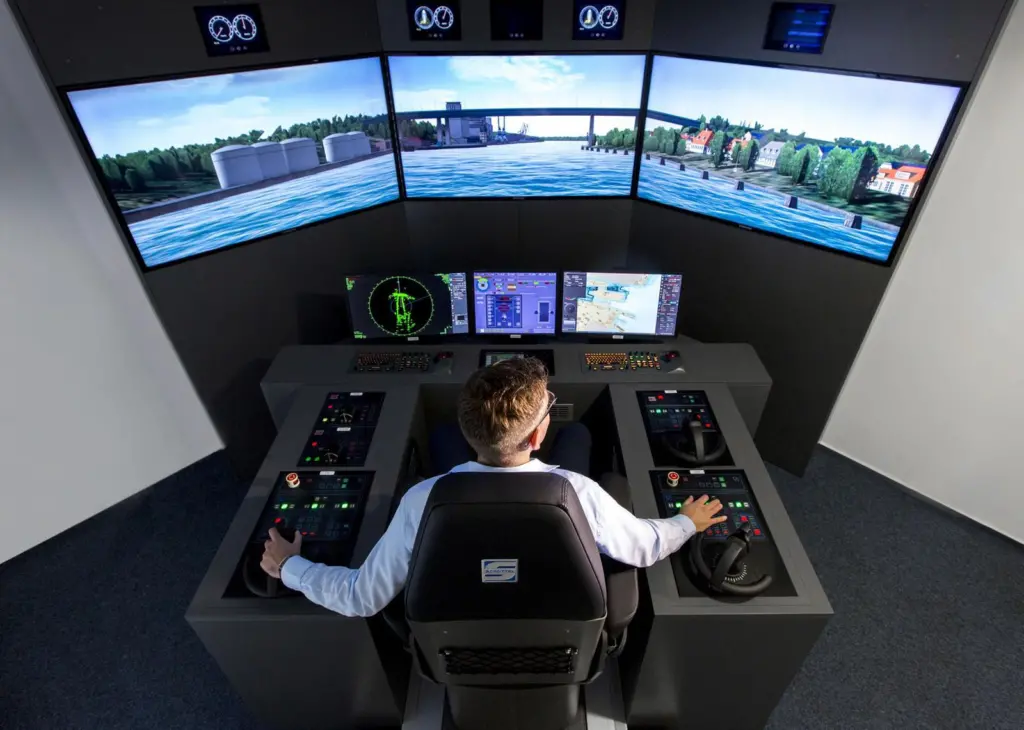
Schottel Academy participants are seated as though on the bridge of a real vessel and can learn how to deal safely with the different systems, control levers, operator panels and displays. Again and again, crews are faced with situations where a fast response is essential – both during their normal work and even more so in emergencies, such as sudden evasive manoeuvres or system failures. The correct response in difficult situations, Schottel argues, must be learnt in such a way as to allow instant recall. Simulators have a decisive role to play in learning the correct sequence of measures to be taken – for greater safety and efficiency.
The simulator has been specially tailored to the requirements of Schottel customers by Schottel instructors and employees of the simulator manufacturer, Transas, and the training personnel have received corresponding qualifications. The training programme currently covers a wide range of different propulsion unit sizes with various configurations in a current total of ten different vessels, with examples including ferries with two units in both the bow and the stern, tugs with two units in the stern and an STT (Schottel transverse thruster) in the bow, and offshore vessels with two units in the stern, an STT in the bow and a retractable unit in the bow. Six ports and waterways are stored in the system, including St. Petersburg, the Bay of Kiel and the Suez Canal.
For many years the German propulsion specialist has placed great emphasis on good training for master mariners, crews and service personnel, either at its company headquarters in Spay or on site at customers’ locations.
By Jake Frith
Related Articles
 OTHER NEWS
 ACCESSORIES & EQUIPMENT
 ACCESSORIES & EQUIPMENT