![MaritimeJournal[Seawork]](https://www.maritimejournal.com/wp-content/uploads/2026/09/MaritimeJournalSeawork.svg)




Tailoring a multipurpose fit
Having a vessel with several different loading capabilities is extremely useful but it inevitably results in a tricky equilibrium – not for the cranes themselves but for the design parameters, Carsten Sietas of TTS Group’s Hamburg subsidiary TTS NMF, tells Maritime Journal.
“This means finding efficient solutions for various loading scenarios is the challenge,” he explains, one that takes in both the physical considerations of the different loads, market realities – and of course, budget.
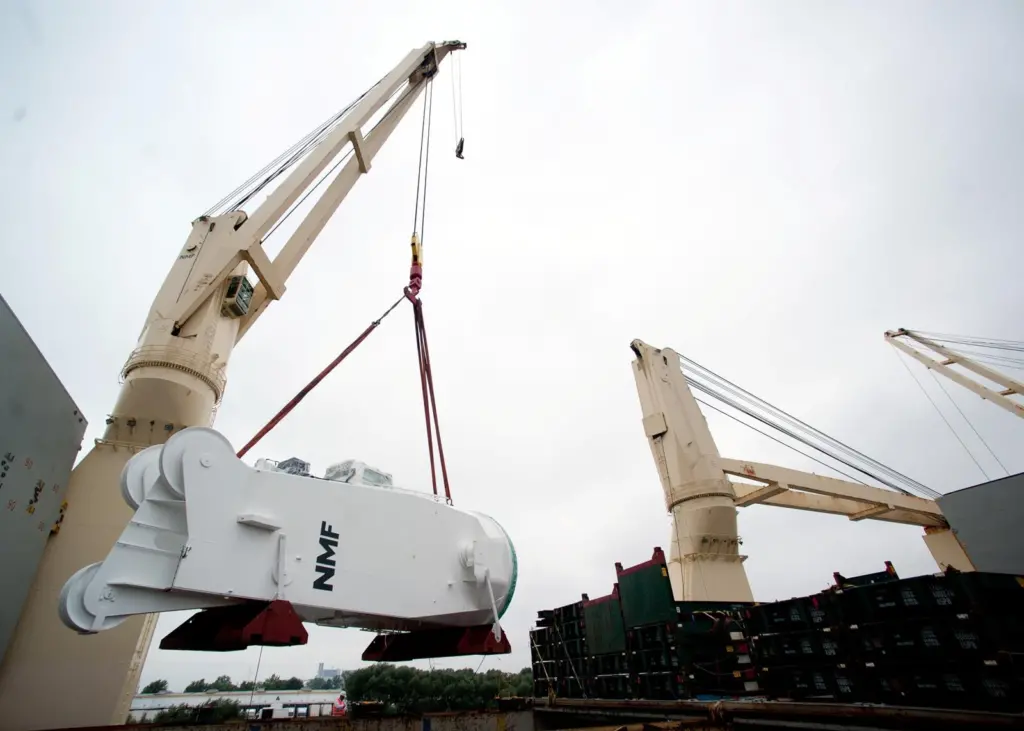
Such is the case for the heavy lift cranes being supplied for five new eco-efficient multipurpose vessels under build in the Huanghai Shipbuilding Co, China. These 12,500 dwt vessels are being equipped a pair of cranes that along with the vessels, “are being optimised for as many operations as possible”, says Mr Sietas, while keeping to the tough bottom line of a NOK100m (£9.45m) contract.
These well known heavy lift DK II units retain their tandem-lift, workhorse capabilities with a 250 tonne capacity at 18m outreach or 100 tonnes when the crane is at its full 33m extension, an unlimited slewing range of 360˚, a two-fall operation on the hook and auxiliary hoists (in this case tailored to 45 tonne capacity). There is also a redundancy in the pump system that comes from doubling up the hydraulics: “You don’t need to abandon the lift in case of failure as you can still handle the full load at half speed,” says Mr Sietas.
However, this application has called for important adaptations. Cranes often demand an outreach that is mapped against a loading ‘band’, but this can restrict operations. So, despite the extra cost, an automatic load moment device gives a sliding scale of response that allows for greater elasticity when it comes to matching outreach to load.
Plus, though these cranes will be primarily looking at outsize and project cargo contracts, they have also been tailored for lifting bulk loads. “If you have a heavy cargo lift, you are going to be limited in speed: the ballasting arrangement needs time and the process usually needs extra safety and stability procedures.”
However, the bulk cargo requirement is very different and it’s quite tricky to get a crane to do both, admits Mr Sietas. “Rather than one heavy load, bulk means a number of smaller lifts, but the owners inevitably want it on board as soon as possible so the hook now has to travel very fast.” This means adapting the crane with separate ‘bulk handling’ programme and an additional cooler to cope with the extra heat generated from the rise in speed.
So, cranes that fit the vessels that fit a broad range of operations are the result.
By Stevie Knight
Related Articles
 OTHER NEWS
 ACCESSORIES & EQUIPMENT
 ACCESSORIES & EQUIPMENT