![MaritimeJournal[Seawork]](https://www.maritimejournal.com/wp-content/uploads/2026/09/MaritimeJournalSeawork.svg)





Taking the Arctic shortcut
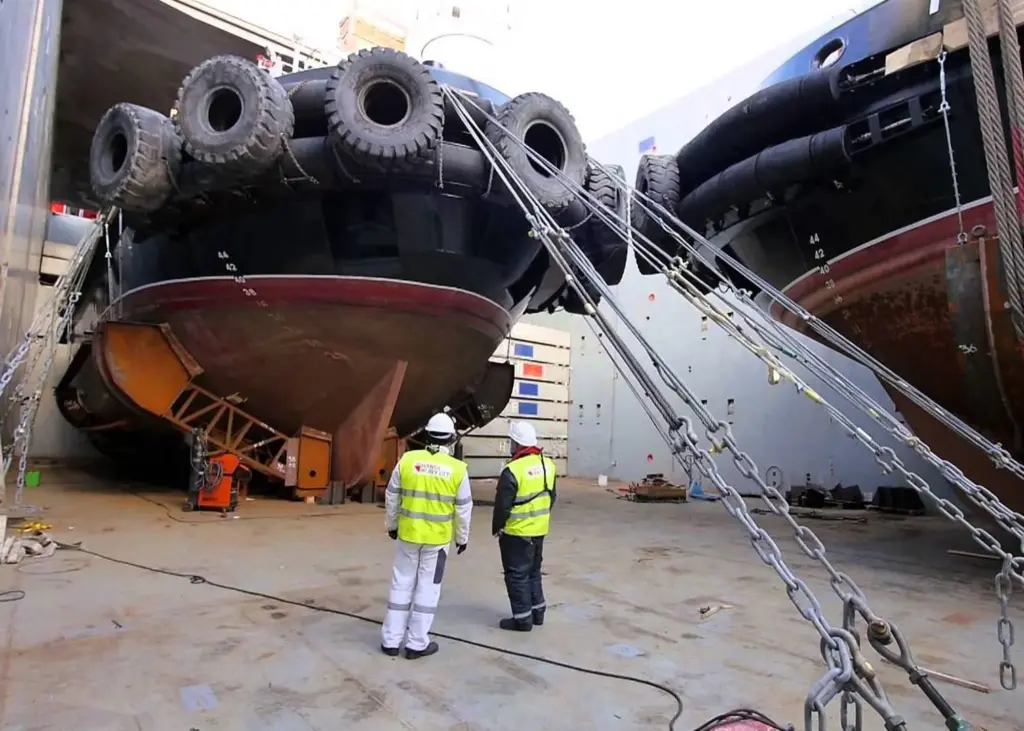
The decision to take a ship from St Petersburg to Vladivostok across the icy Northern Sea Route had a lot resting on it. Specifically, six tugs weighing between 726 and 380 tonnes.
Of course, there is the southerly Suez Canal route, explains Steve Hutty, Hansa Heavy Lift’s Chartering and Operations director, but this is much longer, adding weeks to the journey time and, when it comes to an extremely large ship like the HHL Lagos, a huge amount onto the fuel bill.
This is where the Northern Sea Route begins to look quite attractive, despite the possibility of -40 degree temperatures. However, there were challenges. To start with, it was only the second time a P2 vessel like the HHL Lagos had taken on the Northern Sea Route, and then by the time the tugs were delivered from the Pella Shipyard in St Petersburg, the four month seasonal window was in danger of shutting. Mr Hutty refutes the common fallacy that it’s the new freeze that causes issues. “It’s not the softer seasonal ice formation that’s the problem, it’s the hundred year old ice drifting south which closes the route to shipping. This stuff is harder than concrete and you can’t risk contact with it.”
So, right up to a week before, Mr Hutty and the team still, despite all the careful planning, didn’t know whether the ice route was going to be open or not. “We were running up against the time constraints, and concerned that we may miss the window. Conditions across the Northern Sea Route can change very quickly and there has been a lot of recent publicity about how easy it is to get trapped – we couldn’t risk that.”
However, HHL were in continuous contact with the Northern Sea Route administration: “They said, if you can meet the convoy ice breaker in time, we can get you across, but it meant 12 days to get there.” So it was all systems go.
The loading plan went smoothly at St Petersburg. The tugs were floating units with the divers, a very specialised bunch with a lot of experience and pride in their work, says Mr Hutty, placing the lifting straps under the hulls of each of the boats in turn.
The tandem lifts were taken on by the Lagos own two 700 tonne onboard cranes and meant bringing two of the smaller craft into the hold, and the other four on top, both sets lying diagonally across the deck.
“Obviously we have a very capable automatic ballasting system, a very detailed loading plan, plus HHL also has a cargo superintendent keeping an eye on this part of the operation. It also helped that the cranes weren’t right up against the limits of their capability.”
“Still, there’s a critical point when you have 700 tonnes of boat out of the water, and you have to synchronise the cranes to swing the jibs inboard at the same time,” he explains. Because of their diagonal position, the clearance between some of the tugs’ hulls and the crane structure itself was pretty tight and had to be carefully controlled. “It meant adjusting the height and drop to be able to bring the load between the two pillars,” he says. Despite this, once the cradles were positioned it all went fairly smoothly, apart from a minor issue when one of the receiving cradles turned out at the last minute not to quite match the incoming hull – requiring a bit of emergency packing to take the tug’s load evenly.
And then it was full steam ahead to the rendezvous with the Rosatom nuclear powered icebreakers at Zhelanja Point at the north end of Novayazemlya Island, making it with 12 hours to spare. Mr Hutty explained that the first one of the huge 35,000 dwt breakers, Yamal, carved its way ahead of them for the first half of the journey, handing over the reins to Taymyr on 12 November “so that both could get back to their respective stations on each side of the passage before the weather closed in.”
Despite their vast and capable presence, treading in the wake of an icebreaker is still a delicate journey with a consequent need to keep up a continual flow of information with the vessel ploughing ahead. This was helped no end by the choice of master, Captain Shlychkov being a native Russian himself. All in all the Lagos made good progress, taking around 10 days to get through although the temperature plunged en route from the initial -5 to -35 degrees.
However, one big challenge remained, although it was one that the Lagos was lucky not to have encountered earlier – spray. Coming out of the passage, just as the icebreaker releases, you are looking at the washes of the Bering Strait. With the Arctic waters meeting the Pacific there is always turbulence to deal with. “Just here there’s a very good chance you’ll suddenly meet low pressure air and strong winds,” explains Mr Hutty. The P2 vessels are designed for stability but spray, if it hits the deck and freezes, leads to ice accretion which can destabilise a ship in just a few hours.
“Spray was our big danger, but we monitored the oncoming weather and, frankly, we were lucky. After hanging around for a few hours we saw we could nip in between two approaching low pressure systems. So, we made a run for it, getting across after about four days steaming.”
And then, as he says, “we turned south… home free” on the final leg toward the bay in Vladivostok and the welcome delivery of the six tugs to the port authority.
So, will we be seeing more HHL vessels brave this route? “Certainly,” says Mr Hutty. The Lagos has proved the point. It’s a specialised ship built for ice conditions, with an equally specialised crew that’s careful enough to make the most of a very new market.
There are certain points about the HHL P2 ships like the Lagos that stand out, such as the capable 700 tonne cranes that combine to give a lift of 1,400 tonnes and the cavernous hatch openings, measuring 86m long.
However, there’s the slightly less obvious. This includes things like the flexibility of the ‘tweendecks’ that can divide into a box shaped upper and lower hold if need be, plus it’s ice capability. The P2 fleet hold certification of Ice Class 1A so they can transit sea routes with an ice thickness of up to 1m and have ‘bubble’ devices in the ballast water tanks that stop the water from freezing inside.
By Stevie Knight
Related Articles
 ACCESSORIES & EQUIPMENT
 ACCESSORIES & EQUIPMENT
 ACCESSORIES & EQUIPMENT