![MaritimeJournal[Seawork]](https://www.maritimejournal.com/wp-content/uploads/2026/09/MaritimeJournalSeawork.svg)





The big pull to deeper waters
As energy operations move towards deeper waters, mooring lines become heavier, more difficult and more hazardous to handle.
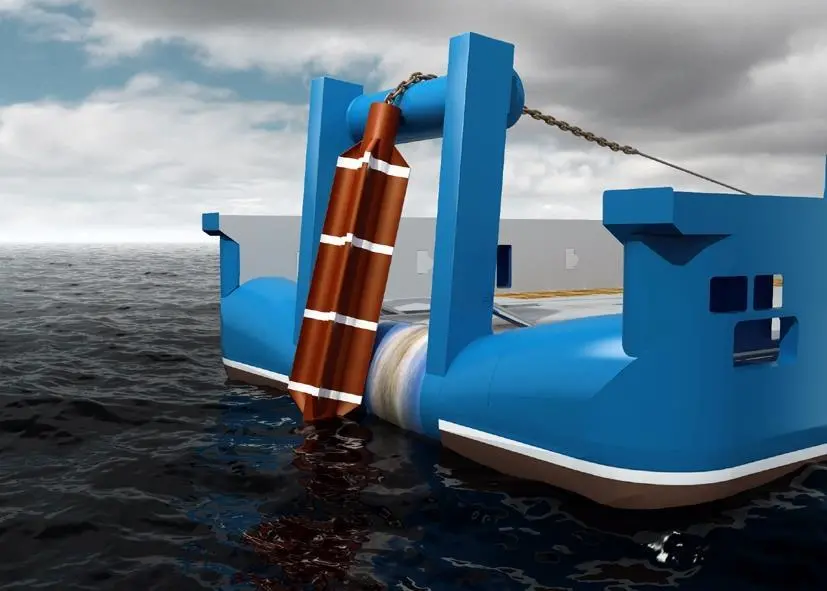
So, a new anchor handling frame (AHF) from Rolls-Royce is designed to reduce the handling forces and wire tension during anchor deployment and retrieval operations, while also minimising the human exposure to hazardous operating conditions.
This AHF, explained Gisle Anderssen of RR’s Offshore Deck Machinery division to MJ, combines the features of a conventional A-frame with additional benefits to help make the aft deck of an anchor handler a safer place to work.
When fully expanded the AHF reaches behind the stern of the vessel. “This makes bringing mooring anchors up simpler, as the orientation of the anchor can be checked before it is pulled onto the deck”, said Mr Anderssen, adding it eliminates the need for frustrating, repeated attempts to get the anchor the right way round.
The AHF is also designed to reduce the handling forces and wire tension during anchor deployment and retrieval operations. This in turn minimises the human exposure to hazardous operating conditions with wire under high tension.
Mr Anderssen added that one of the unit’s key benefits can be seen from the deployment and retrieval of torpedo-type anchors. Since the AHF is flush with the deck while not being used, it leaves the area free for work. Then, to prepare for launch, the AHF starts to rise, pulling the long torpedo-shape into a vertical position while the winch operator simultaneously lowers it, dropping the anchor behind the AHF’s integrated stern roller.
The AHF is part of a £15m contract for the supply of an extensive deck equipment package destined for an advanced anchor handling vessel which will be operated by Iceman AS. Besides this new AHF there is also a hydraulic anchor winch capable of pulling 500 tonnes. It will also feature anchor handling cranes and systems to ensure controlled management of wires and chains when pulling heavy loads.
Related Articles
 ACCESSORIES & EQUIPMENT
 ACCESSORIES & EQUIPMENT
 ACCESSORIES & EQUIPMENT