![MaritimeJournal[Seawork]](https://www.maritimejournal.com/wp-content/uploads/2026/09/MaritimeJournalSeawork.svg)






The rich winch market pull
Unlikely as it seems, the commercial workboat business owes a lot to the Abramovichs and Mansours of this world, explains Tom Loasby of Dorset UK based marine deck equipment suppliers Seaway Powell.
So, although seafarers on commercial workboats may think they have very in little common with a section of the industry that seems to run on conspicuous consumption, a lot of technology rolls down from the superyacht sector. “The fact is that the big yacht owners always want to push the limits, so the development gets a leg up, says Mr Loasby. “These boats have a relationship to the workboat industry that’s similar to the link between Formula One cars and the family saloon.”
Take one example: below deck captive reel winches. “These started out for use on sail control applications. What the superyacht owners wanted was to keep the lines of the deck clear, this was partially aesthetic but it was also about having a very thorough understanding of exactly what was happening onboard right down to the tiniest detail. For this you need a good view from all the CCTV points.”
Even casual investigation shows commercial workboats sharing some of the same considerations, if for different reasons. They are notable for a tight environment that has to accommodate large and heavy pieces of equipment, so there’s a premium on a clear working deck. “There’s definitely a growing interest in putting the winch reels underneath the deck as it frees up a lot of very useful space”, says Mr Loasby Furthermore, some of the larger vessels have a use for CCTV to take care of the more remote equipment.
Also, the superyachts have demanded as much automation as possible, not just because of the ‘James Bond’ experience, but because as these vessels have evolved into truly huge beasts, the ability for the crew to manually control the increased loads on the deck equipment became an issue. So there has been a call for a lot of very compact, electrically controlled kit.
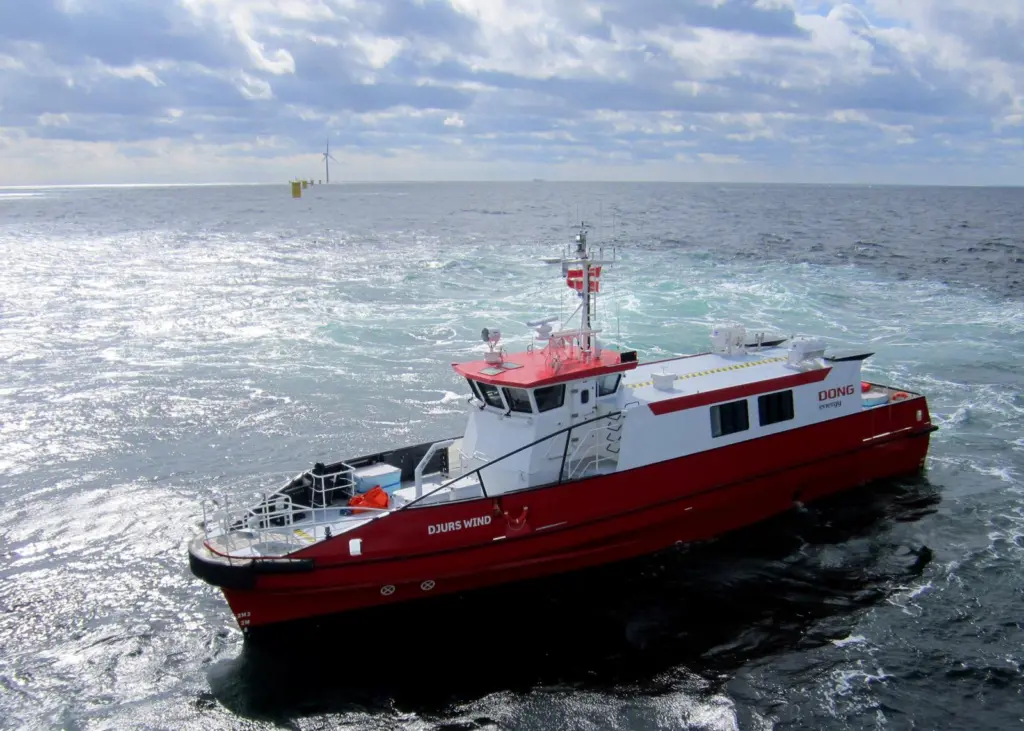
“All these things have their uses in other scenarios”, points out Mr Loasby, explaining that Seaway Powell has developed a horizontal ultra-lightweight anchor windlass that is now gaining popularity with workboat applications such as passenger ferries and wind farm support vessels despite having roots in the superyacht industry. For example three HHAW 10-12 units, the smallest of the series, recently went to Hvide Sande Skibs &-Baadebyggeri (HSSB) for the latest in a series of crew transfer vessels, the Kattegat Wind.
However, despite their 115kg weight and 400mm by 775mm footprint, these units don’t lack power. The HHAW 10-12 DNV type approved windlass gives 10kn of pull at a speed of 12m per minute and can be run either from a dedicated hydraulic power unit or the vessel’s own hydraulic supply. It also has a powerful, controllable hub brake which eliminates a cable stopper and its clutchless operation guarantees anchor free-fall in any conditions. “It means that if you suddenly need to drop the load, you can just release the valve”, points out Mr Loasby.
By Stevie Knight
Related Articles
 ACCESSORIES & EQUIPMENT
 ACCESSORIES & EQUIPMENT
 ACCESSORIES & EQUIPMENT