![MaritimeJournal[Seawork]](https://www.maritimejournal.com/wp-content/uploads/2026/09/MaritimeJournalSeawork.svg)



Wrap-around crane design provides more lifting options
An innovative ‘wrap around the leg’ crane is GustoMSC’s way of providing efficient installation lifts and of freeing up the deck for the storage of wind turbine modules.
While the technology isn’t new, recent applications are certainly pushing the envelope.
The original question about how and where you locate a crane onboard wind farm installation vessels, such as GustoMSC’s new NG-9000C design, highlights a clash of priorities, explains the Dutch company’s business development manager Gerrit Jan Schepman. The company has been long-established in jack-up and other offshore unit designs and is now also making a name for itself in the wind turbine installation vessel field.
‘Locating the crane at the edge of the free deck area means that the deck area served by the crane hook is maximised,’ Mr Schepman told MJ. ‘However, although positioning the crane close to the side of the jack-up gives the most effective use of the crane’s outreach, the work space is then obstructed by the legs.’
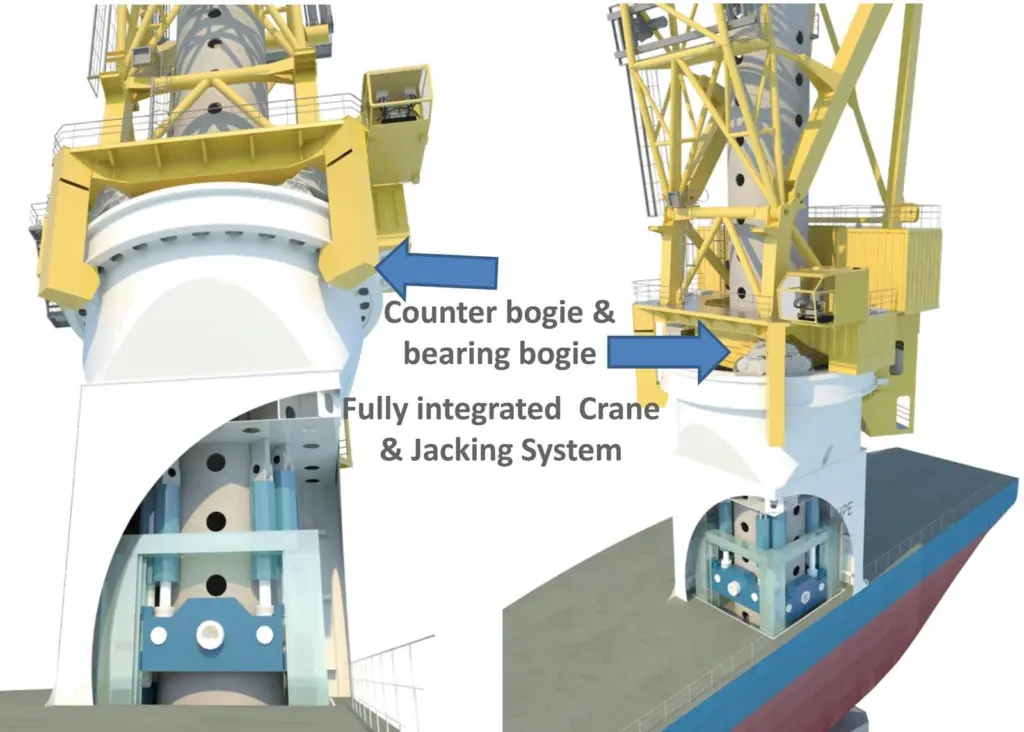
Mr Schepman said the obvious solution is to arrange the crane around one of the jack-up legs itself, with this piercing the centre of the crane.
There are five builds presently underway with this crane set up. It’s not a new trick, as in 1968 the Gusto shipyard built the jack-up Cowrie One, which had a small crane around the leg. However, the NG-9000C’s crane specifications are much more ambitious than previous builds.
The main hoist has a capacity of 800 tons at 24m outreach, and 480 tons at 36m in ‘split mode’. These cranes are capable of lifting a maximum load at a minimum 24m radius with a dynamic factor or 1.1. The crane has a hoisting height of 77m above the heel point, two 5 ton tugger winches and a man riding capacity of 3 tons.
Mr Schepman explained the wrap-around crane diameter means that a standard bearing system can’t be applied. Therefore, the base of construction vessel cranes (typically with a lifting capacity of 4,000 to 5,000 tons) is located on a circular bulkhead.
This large diameter tub supports a bearing system composed of bogie wheels. The whole structure is placed on top of the jack house, thus providing sufficient internal free opening for the leg to penetrate. The fitting of individual sets of bogies to compose the bearing system also serves to decouple the construction of crane and jack-up leg. On top of the A-frame, the boom hoist tackle is split symmetrically left and right to bypass the jack-up leg in all boom luffing positions.
This means the wrap-around cranes can revolve 360° around the jack-up leg, combining a long outreach with an extremely short minimum radius, making it suitably for the kind of heavy, flexible work that wind turbine installations typically require.
Related Articles
 ACCESSORIES & EQUIPMENT
 ACCESSORIES & EQUIPMENT
 ACCESSORIES & EQUIPMENT