![MaritimeJournal[Seawork]](https://www.maritimejournal.com/wp-content/uploads/2026/09/MaritimeJournalSeawork.svg)





IHC launches Mahury and speeds strategy
The Netherlands’ Royal IHC has launched the 1,840m3 capacity twin-screw trailing suction hopper dredger’ Mahury’ at partner shipyard MTG Dolphin Shipyard in Varna, Bulgaria.
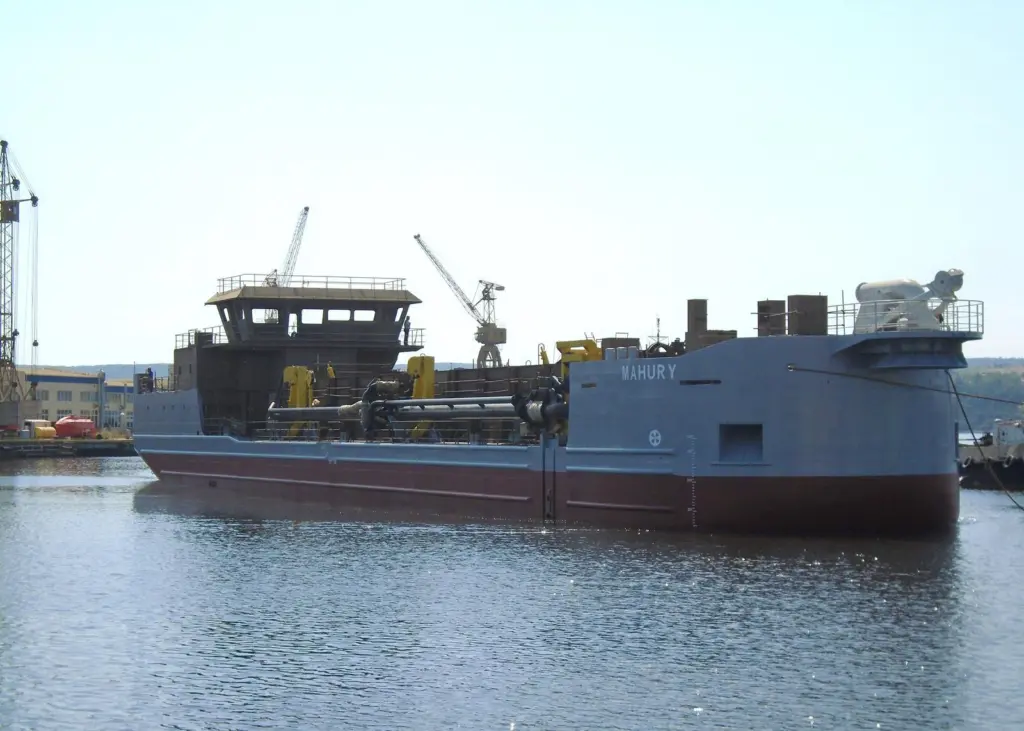
The vessel is being built for Baggerbedrijf de Boer (Dutch Dredging) and is that company’s fourth IHC-built vessel, following Albatros, Lesse and Amazone. Mahury is an upgraded version of the Albatros, which was delivered in 2013 and was well received by the customer. The Mahury includes two dredging marks in its design that allows the vessel to operate at different distances from the shore, while still adhering to regulations. The first dredging mark is for operating within 15 miles from shore, and the second within 8 miles from shore.
“Dutch Dredging required an efficient, versatile dredger, with high levels of productivity and the Mahury will serve as an excellent addition to its expanding fleet of IHC-built vessels,” says André Kik, product director at IHC. “The relationship between our two companies is based on high levels of trust and cooperation, and we are proud to work alongside Dutch Dredging as one team.”
The Mahury is scheduled for completion on 31 December 2015, ten weeks before the contracted date. The 75m LOA will be able to work to depths of 30m through a single 600mm diameter dredge pipe. Total installed power of 2,440kW will allow the vessel to sail at 9.3 knots.
The launch comes against the backdrop of what Royal IHC sees as a rapidly deteriorating market, which has sped the decision to accelerate the implementation of its ‘IHC 2020’ strategy, which was announced in 2014. This strategy aims to reduce IHC’s dependence on the volatile shipbuilding industry. IHC will focus on the design and production of technologically complex, integrated dredging and offshore vessels, and aims to extend its equipment offering, and to further develop its OPEX activities, such as service and rental activities.
Economic developments in the markets in which IHC operates at present are seen as extremely challenging. A decline in oil prices, intensifying and internationalised competition, and the customer’s changing selection dynamics, are forcing IHC to take action. This means that IHC will have to realise substantial cost reductions and increase its competitiveness to ensure a stable and economically sound business in the future.
The implementation of the strategy set out for 2020 will be accelerated. The number of slipways in The Netherlands will be reduced from four to two and the acquisition of additional foreign building capacity will be realised sooner than planned.
These measures also affect the number of jobs. IHC intends to terminate the employment of 487 of its employees. Simultaneously, a large percentage of the flexible workforce (a total of 1,127 employees), will be phased out. The aim is to achieve the targeted reduction by the end of 2this year. This is all subject to the achievement of agreement with relevant parties, such as trade unions.
By Larz Bourne