![MaritimeJournal[Seawork]](https://www.maritimejournal.com/wp-content/uploads/2026/09/MaritimeJournalSeawork.svg)



Developing next generation turbine installation crane technology
DEME Offshore and Liftra ApS are developing a new vessel offshore installation system to cater for the next generation of offshore wind turbine generators.
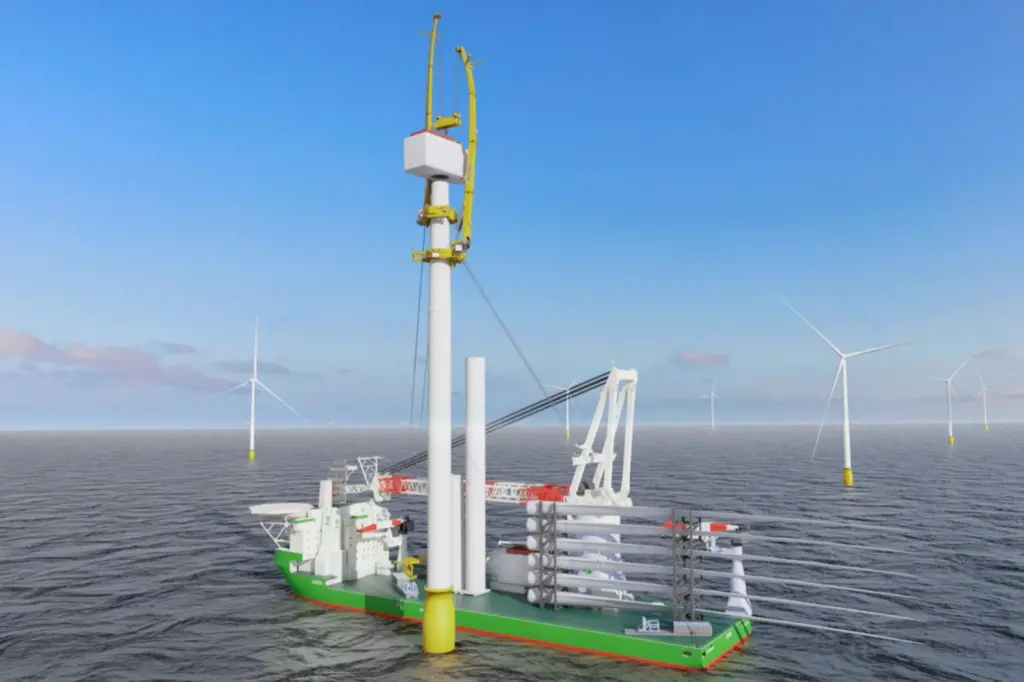
The system, which is based on Liftra’s patented LT1500 turbine installation crane technology, will be fully integrated on board DEME’s offshore installation vessels.
“DEME Offshore is excited to again bring a game-changing installation concept to the industry,” said Bart de Poorter, general manager, DEME Offshore Renewables.
”There are many advantages of this new joint technology, the major one being the ability to install fixed or floating turbines from a floating vessel, which naturally means there are no limitations regarding water depth. As well as this, there are no longer any lifting height issues and relative motions at high heights can be controlled.”
State-of-the-art
The offshore turbine installation crane also reduces the environmental footprint on the seabed at the windfarm’s location and in port.
It offers the possibility of erecting higher and heavier turbines using existing vessels at a lower cost, while at the same time reducing the environmental footprint. It is suitable for both bottom-fixed and floating turbines.
Per Fenger, CEO of Liftra, said: ‘’Liftra is proud to contribute with our innovative LT1500 installation crane technology which is based on ten years of self-hoisting crane product experience. The special configuration with two cranes working in parallel, is also proven and goes back many years.”
”Liftra is thrilled to team up with DEME, given its entrepreneurial drive and proactivity to bring state-of-the-art offshore solutions to the wind turbine industry.’’
Due to its flexibility, the system will be able to be integrated for use on board DEME’s floating offshore heavy-lift vessels including ‘Orion’ or ‘Green Jade’, as well as its existing jack-up vessels.
The partners will develop and integrate the technology in stages and following an extensive testing programme. The new system is expected to be operational in 2027.
Related Articles
 FEATURES & VIDEOS
 ENVIRONMENT
 OTHER NEWS