![MaritimeJournal[Seawork]](https://www.maritimejournal.com/wp-content/uploads/2026/09/MaritimeJournalSeawork.svg)



France cuts offshore wind target by 20% in more ‘prudent’ trajectory
France has quietly cut its 2035 offshore wind target from 18 GW to 15 GW, according to the final version of its new Multi-Year Energy Plan (Programmation pluriannuelle de l’énergie – PPE3).
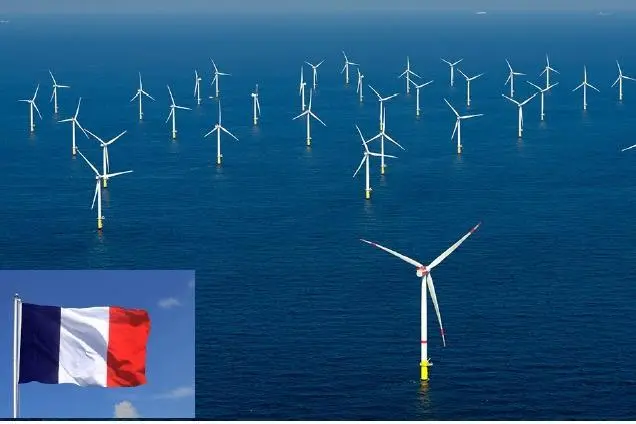
The shift marks a recalibration of the country’s renewable‑energy ambitions as the government acknowledges delays, constraints and a slower‑than‑expected pace of electrification across the economy.
The PPE3 sets out France’s energy strategy for 2026‑2035, an offshore wind objective of 15 GW ~59 TWh by 2035, replacing the previous planning assumption of 18 GW by that date. It also sets out a target of installing 18 GW by 2037.
Offshore wind is the only major renewable technology in the PPE3 to see its 2035 target lowered.
Reasons for cutback
One of the most explicit reasons for the downward revision is the sluggish pace of electrification across transport, heating and industry.
“The delay observed in the shift from using fossil fuels for electricity has driven a downward revision of the trajectory for decarbonised electricity production,” the document says (in French).
It also says it has been forced to give up on increasing annual caps on renewable energy capacity, and that because offshore wind is among the costliest and slowest technologies to deploy, it is the main casualty of this adjustment.
The PPE3 also highlights deep structural obstacles in the French offshore wind permitting system, citing lengthy appeals and delays that have slowed early project delivery and prevented the PPE2 target of 2.4 GW by 2023 from being met. As of the end of 2023, France had just 0.84 GW installed.
The government says recent laws such as the 2020 ASAP law and the 2023 APER law are expected to speed up procedures, but their impact will not be fully visible until the 2030s.
The document points to constraints in connection capabilities, the need for integration in the grid and a requirement for a more gradual scale-up of the sector as further reasons behind the new trajectory. France must adapt ports, manufacturing sites and transmission infrastructure to handle larger volumes before it can accelerate again.
A more cautious path, the PPE3 argues, is essential to ensure the balance between supply and demand, security of supply and industrial coherence.
Spatial‑planning and environmental limits
Marine spatial‑planning constraints also play a role.
The PPE3 references the need to integrate offshore wind development with “environmental issues, biodiversity, fishing and landscapes” within newly mapped priority zones following a major 2023‑2024 public debate and the inter-ministerial decision of 17 October 2024.
While the 2035 figure has been lowered, France still plans a long‑term roll-out. The PPE3 confirms a trajectory towards 45 GW of offshore wind in service by 2050, with large‑scale tenders of up to 10 GW scheduled for this year.
Related Articles
 DREDGING & FLOOD DEFENCE
 ENVIRONMENT
 FEATURES & VIDEOS