![MaritimeJournal[Seawork]](https://www.maritimejournal.com/wp-content/uploads/2026/09/MaritimeJournalSeawork.svg)



Japan signs 3rd MoU with Europeans to target floating wind
Japan’s Floating Offshore Wind Technology Research Association (FLOWRA) has signed an MoU with France Energies Marines (FEM) to develop technologies in floating wind.
The two parties aim to set up a partnership that will cut development costs and grow the sector with joint technology initiatives.
It is the third agreement this year for FLOWRA, which in September signed a similar MoU with the Scotland-based European Marine Energy Centre (EMEC) to develop the technology and in March received UK government association ORE Catapult to investigate the same.
Separately, FLOWRA announced another MoU with ClassNK to ‘technology development cooperation in the field of offshore wind’.
International research firm Zero Carbon Analytics says that while Japan has vast potential for offshore wind generation – more than 9,000TWh per year, it quotes the International Energy Agency as estimating – most of this is in deeper waters further offshore.
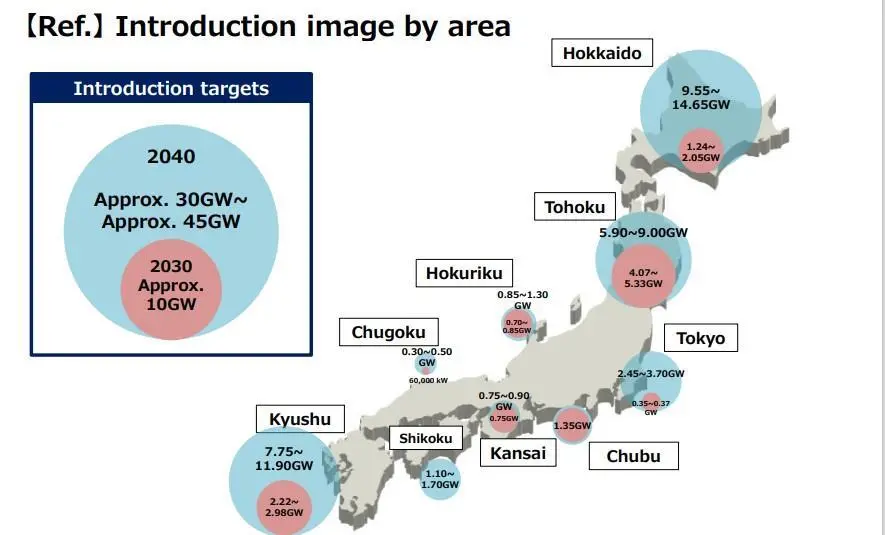
“In 2022, there was 91MW of offshore wind in Japan, 5MW of which was floating offshore wind,” it says. “While this is a low level of deployment compared with some other countries, the government has increased targets for awarding contracts for offshore wind energy to 10GW by 2030 and 45GW by 2040.” This includes floating wind.
The aim is to build 1GW a year, although the research organisation accepts the targets will be tough to meet given the years needed to develop and build wind farms offshore.
Japan’s ambitions were set out in a 2020 ’vision’, in which the ‘Public-Private Council oin Enhancement of Industrial Competitiveness for Offshore Wind Power Generation’ said while Europe was leading the way, rapid growth was expected in the Asian market, particularly in China, Taiwan and South Korea.
“Currently, most offshore wind power manufacturers are located overseas, but there are potential suppliers in Japan as well,” it says.
The council’s ‘vision’ includes recommendations on port infrastructure building and grid improvements with an eye on the increasing size and generation of turbines. Base port building is under way at four locations (Noshiro, Akita, Kashima and Kitayushu ports) throughout Japan to strengthen soil-bearing capacity necessary for the larger sizes, it says.
As well as targeting up to 45GW by 2040, the council says 60% of that should be Japan sourced, which will be assisted by government subsidies and tax breaks, it says.
”In Japan, we will also take inventory of skill and labour requirements for offshore wind power generation and explore ways to acquire these skills through collaboration between industry, government and academia,” the council says, which ultimately it will hope lays the groundwork for overseas deployment of floating wind.
Related Articles
 FEATURES & VIDEOS
 ENVIRONMENT
 OTHER NEWS