![MaritimeJournal[Seawork]](https://www.maritimejournal.com/wp-content/uploads/2026/09/MaritimeJournalSeawork.svg)





Scotland on the move to lead UK with offshore wind
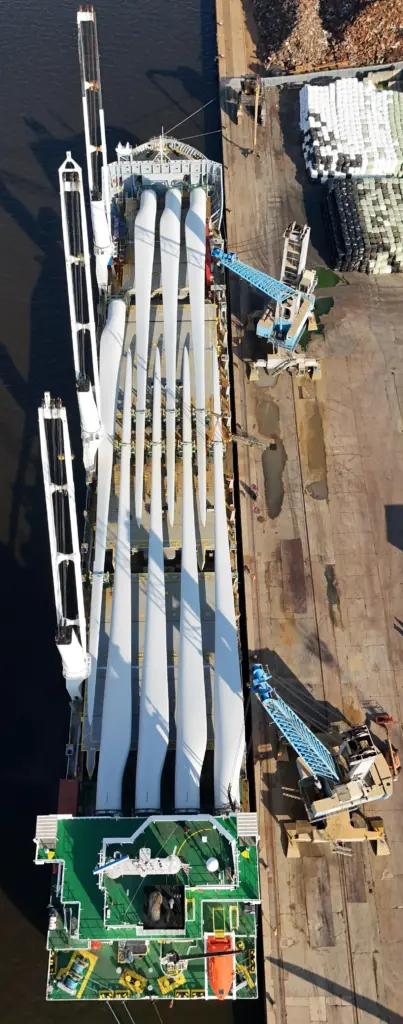
Wind turbine blades more than 80 metres long have been handled for the first time at a Scottish port after it spent more than £3 million (€3.4 million) on infrastructure to accommodate them.
The achievement is a sign of Scotland’s determination to lead the UK in offshore wind deployment.
Peel Ports Clydeport had six of the blades delivered to its King George V dock after a new egress road and other terminal infrastructure were developed so that such cargo could be moved through the port.
They came from China on the BBC Raise vessel, and went on to a wind farm project near Ayrshire.
“This is a clear demonstration of how we’re future proofing our operations to meet the evolving needs of the energy sector and helping deliver on national net-zero ambitions,” said Jim McSporran, port director.
Over the next 12 months, more than 100 turbines and 800 wind turbine components will be processed at the site, he said, breaking 2024’s record.
Peel Ports is the UK’s second largest port operator, with six ports under its management, including Liverpool, Manchester Ship Canal and Great Yarmouth. The ports handle around 70 million tonnes of cargo a year.
In a speech delivered to the Global Offshore Wind Investment Forum in March, Scottish first minister John Swinney said he estimated the potential capital value of Scotland’s offshore wind market could be around £100 billion (€115 billion) ‘given full deployment of the potential pipeline’.
”Our geographic location not only provides us with naturally occurring strong winds, it places us on the doorstep of large European markets with existing deep sea ports infrastructure,” he said.
“The European Union urgently seeks to ensure its energy independence and the proportion of its energy that comes from renewables. We are in an ideal position to meet those needs here in Scotland.
“To go along with our location, is our history. We have long decades of offshore experience thanks to our proud heritage in the North Sea oil and gas industries. That heritage and the skills that come from it – combined with our world leading subsea engineering capabilities – give our workforces the experience and expertise needed to capitalise on the opportunities provided by offshore wind.”
According to the trade association Offshore Energies UK, the UK had 15 GW of installed offshore wind capacity at the end of 2024, and is the second largest market in the world after China.
Related Articles
 FEATURES & VIDEOS
 ENVIRONMENT
 OTHER NEWS