![MaritimeJournal[Seawork]](https://www.maritimejournal.com/wp-content/uploads/2026/09/MaritimeJournalSeawork.svg)






The top 10 technologies lowering tidal energy costs
A new industry-leading report identifies ten technology innovations that it says are key to unlocking 80% of UK tidal energy cost reductions.
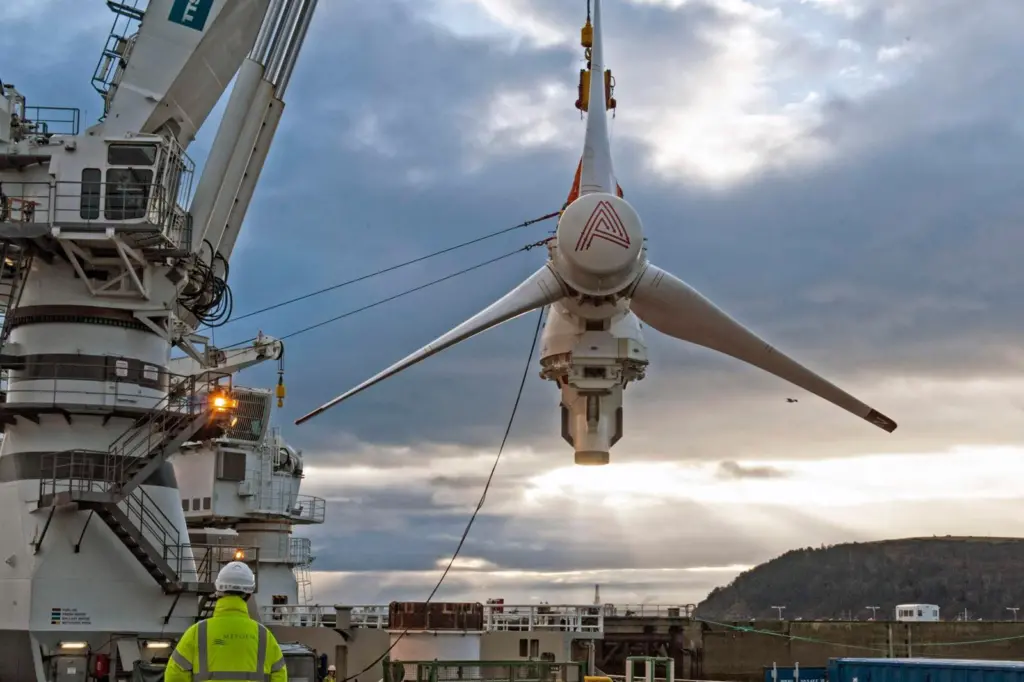
The Tidal Stream Technology Roadmap report, published by the Offshore Renewable Energy (ORE) Catapult, said that the innovations could make the cost of tidal stream energy lower than current nuclear energy prices – if successfully commercialised.
“Our new report demonstrates how and where cost reduction can be achieved through technology innovation, creating significant growth in the UK tidal industry,” said Simon Cheeseman, Wave and Tidal Energy Sector Lead at ORE Catapult.
“With rising costs and the need to adapt to a varied future renewable energy mix, we have identified key drivers in how tidal energy can reduce UK energy system costs by up to £600 million a year and play a full part in the net zero revolution.”
Commercial drive
The technology innovations highlighted in the 2024 report support 1GW of tidal stream being installed in the UK by 2035, in line with UK Marine Energy Council (MEC) recommendations.
They include subsea hubs, anchors for floating devices, controllers to optimise lifetime turbine performance, cable monitoring and tidal array optimisation.
In an ‘optimistic’ cost reduction scenario outlined in the report, the innovations were projected to support a reduction in tidal stream cost from the current £259/MWh to £50/MWh by 2035.
However, the report also highlights that further research and development in technology innovation will fail to secure an accelerated project pipeline for tidal energy without appropriate policy support to boost continued deployment and private investment to drive commercialisation.
It identifies the need for an increased ringfence for tidal stream energy within the UK Government’s Contracts for Difference (CfD) scheme and reforms to the CfD process to recognise non-price benefits generated by renewable energy projects, such as system integration and supply chain development, rather than focusing on lowest price bids.
The top 10 technology innovations
- 1. Step Change in Rotor Diameters – By increasing rotor diameters, a greater area of tidal flow can be captured, and from this, higher yields can be achieved on a turbine of a given capacity.
- Subsea Hubs – These enable multiple TS turbines to be connected to a single export cable. In doing so, cabling requirements for TS projects can be massively reduced, all of which becomes of critical importance once TS arrays reach commercial scale.
- Array Optimisation to Minimise LCoE – By optimising the spatial arrangements of turbines in a given array, yield and turbine loading can be minimised resulting in lower LCoE across a TS project’s lifetime.
- Innovative Anchors for Floating Devices – By transitioning from gravity based to rock bolt anchoring solutions, significant reductions can be made in material usage, environmental footprints, and the time taken to install floating TS devices.
- Step Change in Rated Generator Power – By increasing the rated power of the turbines used in each array, less turbines can be installed for a site of a given capacity. With less turbines required, less cabling and supporting infrastructure is needed, all of which play a role in reducing O&M requirements across a TS project’s lifetime.
- Controllers that Optimise Lifetime Turbine Performance – Control strategy algorithms allow turbines to generate higher yield across the range of flow speeds they encounter as well as minimise turbine loading. This increases revenue and lowers O&M requirements across a project’s lifetime.
- Optimised Foundations for Fixed Devices – By transitioning from gravity based to piled foundations, significant reductions can be achieved in the material usage and environmental footprints of fixed TS turbine foundations.
- Optimising and Standardising Wet Mate Connectors – Wet mate connectors enable faster and cheaper installation and retrieval of TS devices. However, many wet mate solutions for the TS industry remain either highly bespoke or sub-optimal for the devices they are being connected to.
- Condition Monitoring of Cables – Having effective condition monitoring allows potential faults and failures to be detected earlier and plays a key role in minimising turbine downtime.
- Optimised Individual Pitch Control – Enhanced control of individual blade pitch angles enable greater yield and load management to be achieved across the full range of flow speeds that a TS turbine encounters.
Related Articles
 FEATURES & VIDEOS
 ENVIRONMENT
 OTHER NEWS