![MaritimeJournal[Seawork]](https://www.maritimejournal.com/wp-content/uploads/2026/09/MaritimeJournalSeawork.svg)






WEC enters final tests
Bombora Wave Power is beginning its final test and assembly phase of a ground-breaking project to validate the world’s most powerful wave energy converter (WEC).
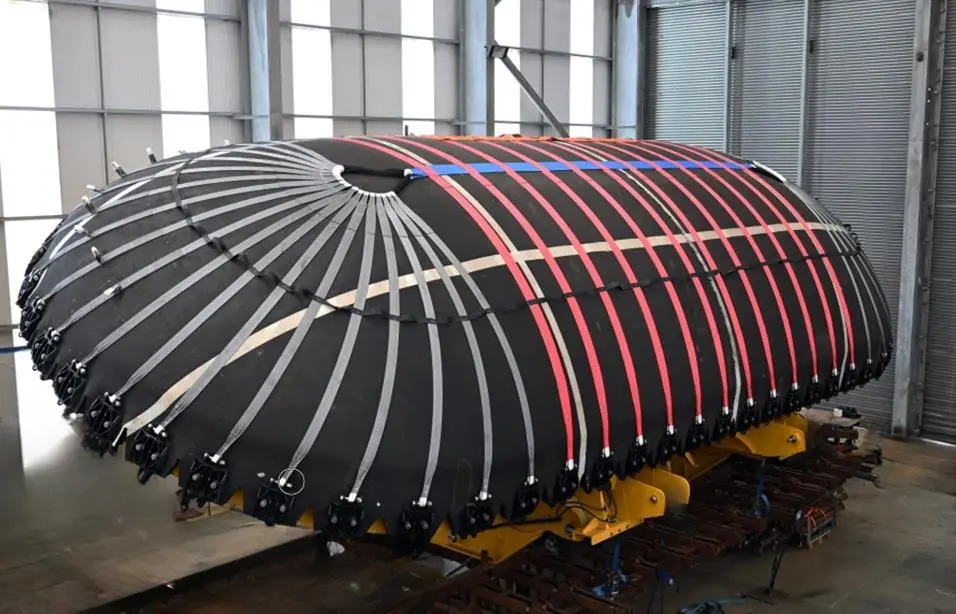
The £20 million (€23.6 million) Pembrokeshire Demonstration project, funded by the European Regional Development Fund via the Welsh government, aims to deliver 1.5MW of clean, renewable energy.
The cell modules, a key element of the firm’s ‘membrane-based’ WEC system, mWave, are now being put through their final paces before being fitted into the steel foundation structure in Pembroke Dock on the Welsh coast.
“The project has been progressing at pace, with our specialist mWave cell membranes currently undergoing final tests, with extreme inflation and deflation cycles,” said Bombora’s chief operating officer, Dave Rigg.
“This is the culmination of the full-system testing process involving detailed instrumentation, operation of the valve systems and powering of the power take-off module.
“In the coming months we will complete the final assembly process on the quayside in Pembroke Dock before loadout to the operational site at East Pickard Bay, where the mWave technology will be validated in the open ocean.”
Bombora’s mWave system involves a series of air-inflated cells mounted into a steel structure secured beneath the surface. As waves pass, air is squeezed out of each cell in sequence, passing through valves into a system fitted with a turbine before being recirculated to refill the modules once the wave has passed.
The unidirectional axial flow turbine is directly connected to a variable-speed generator to produce the electricity.
The 900 tonne 1.5MW mWave is 75 metres long, 15 metres wide and 6 metres high. mWave cell modules can be configured to suit either fixed-bed nearshore foundation systems or floating offshore ocean environments.

Related Articles
 ENVIRONMENT
 DREDGING & FLOOD DEFENCE
 ENVIRONMENT