![MaritimeJournal[Seawork]](https://www.maritimejournal.com/wp-content/uploads/2026/09/MaritimeJournalSeawork.svg)





Solé develops 76kW hydrogen fuel cell for marine applications
Spanish marine engineering firm Solé Advance has developed a 76kW proton-exchange-membrane (PEM) hydrogen fuel cell for integration with marine electric and hybrid propulsion systems, and onboard power generation.
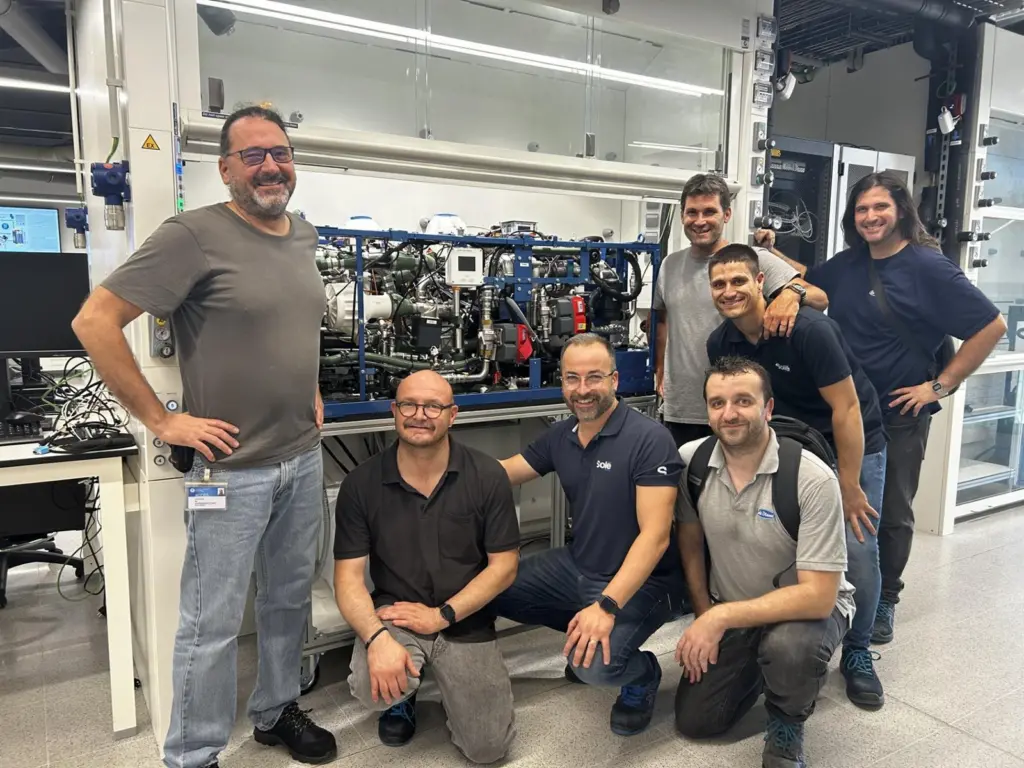
The development is part of the company’s research and development programme and is currently in the validation phase.
The initiative includes technical collaboration with Applus+ IDIADA, an automotive engineering and testing company, and the H2Lab at the Universitat Politècnica de Catalunya (UPC).
The fuel-cell stack was supplied by EKPO, a German fuel cell technology manufacturer, with Solé responsible for the design of the system’s balance-of-plant components, including thermal and air management, humidification, purging systems, power supply and protective elements.
The company is also working on marine-specific integration, focusing on control systems, cooling arrangements, safety requirements and resistance to saline environments.
“This programme is a natural step in our evolution towards next-generation onboard power systems and technological transition: integrating a 76kW hydrogen fuel cell with safety, efficiency and maintenance criteria tailored to real operation on board, in both leisure and workboats,” said Marieli Solé, CEO of Solé.
A first integrated prototype has been assembled and underwent initial testing at UPC’s hydrogen laboratory, according to the partners involved. The unit has been designed to be compact enough for installation in confined engine room spaces while still being accessible for servicing.
“Initial tests at UPC’s laboratory have been encouraging,” said Víctor Miravet, director of Engineering & Manufacturing at Solé. “Our next step is to transfer those results to real operating conditions on a vessel, ensuring optimal cooling, consolidating a robust energy solution within an interconnected onboard energy ecosystem, developing control strategies for the most efficient power management possible, and paying special attention to corrosion resistance.”
The system has the option for higher power configurations by operating other units in parallel. It targets electric and hybrid propulsion arrangements as well as auxiliary power production for both leisure and commercial vessels.
The fuel cell has been engineered to accommodate operational characteristics common in marine use, including repeated start-stop cycles, partial load operation and vibration.