![MaritimeJournal[Seawork]](https://www.maritimejournal.com/wp-content/uploads/2026/09/MaritimeJournalSeawork.svg)


Underwater images move out of the shadows
A new scanner that provides easily read underwater images will prove useful at the smaller end of the commercial workboat market.
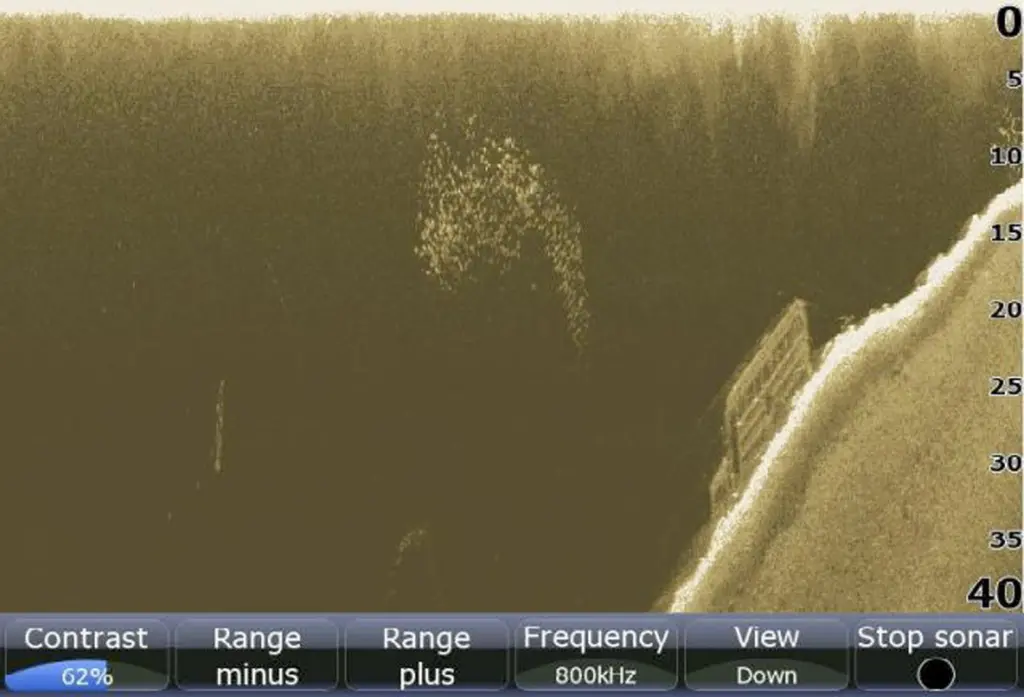
The Lowrance Structure Scan was actually developed for the leisure boating industry, but its imaging provides three dimensional pictures which are quite different from those produced by traditional fish finders. The system has obvious advantages, especially when linked up to one of the bigger HDS displays. One is that the boat can take in a wide swathe, as two transducers give a 60º arc to each side as well as getting input from directly below the hull for a fully panoramic view.
The images themselves are what a diver might expect to see if up close and shining a torch. These are composed by an ingenious ‘black box’ which takes the three sets of input data provided by the multiple transducers and creates from them a three dimensional effect, which includes shadows.
‘Shadows are important to get a true picture, Chris Greetham of Navico told MJ. ‘These give an object’s shape, size and distance in a way that is easily readable, because shadows make information visible in a format that your eyes are already tuned into.’
It is an innovation that makes scanning easier all round, because as objects become distinct from one other, the viewer can, for example, tell fish from other objects. In the demonstration image shown, a rather eerie sunken school bus is seen so clearly that even the windows are visible.
Another useful feature of the Structure Scan is that a boat can still keep a lookout for interesting areas on the seabed while at speed. ‘You can keep up a speed of around 25 knots, and by tapping a screen, mark any waypoint which is of interest,’ explained Chris Greetham. This will then display a marker on the map as well as giving accurate latitude and longitude points, enabling the user to scroll back in the scanner memory to review it, and decide whether to have a better look later.
Chris Greetham adds that the accuracy helps in other ways. Tap the screen when seeing the start of an object, then tap it again at its end point and a quick review of the data on screen will estimate the objects size.
This is a bonus for anyone requiring a detailed look at harbours or other seabed areas for detritus, dangerous or damaged structures, or even a good old fashioned treasure hunt. And fish, unfortunately, will find it even harder to get away.