![MaritimeJournal[Seawork]](https://www.maritimejournal.com/wp-content/uploads/2026/09/MaritimeJournalSeawork.svg)






Coastlink: Unlocking the huge potential of coastal shipping
Delegates at this year’s Coastlink conference heard calls for faster investment, stronger policy backing and better industry collaboration to unlock the potential of coastal shipping and inland waterways.
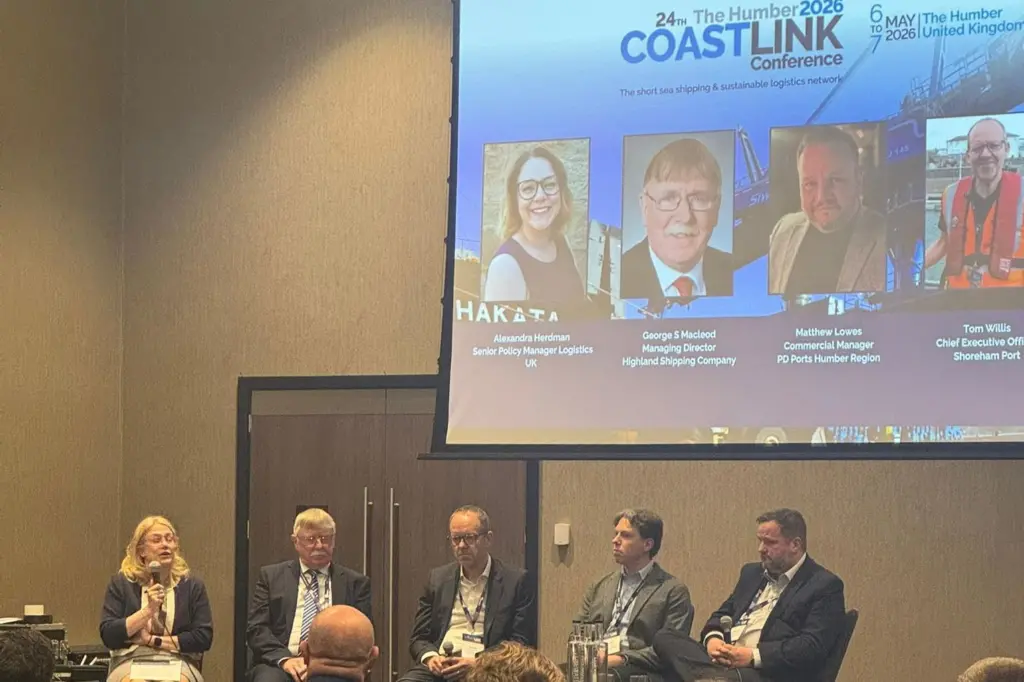
The event, held this year at the Port of Hull UK and hosted by ABP Humber, brought together vessel operators, ports and logistics specialists to discuss how coastal shipping can reduce road congestion, lower emissions and strengthen regional supply chains.
The final panel session of Coastlink this year, titled “Port-centric logistics: Unlocking coastal shipping and inland waterway distribution”, moderated by Alexandra Herdman of Logistics UK, focused on how port logistics networks can scale beyond pilot schemes into mainstream freight distribution.
Green alignment
George S Macleod, managing director of Highland Shipping Company, said inland waterways and coastal shipping projects must align with wider decarbonisation goals.
“What we don’t want to be doing is supporting a green renewable project while not being as green as we can ourselves,” he said, outlining the company’s work transporting materials for renewable energy developments in Scotland.
Mr Macleod described how one storage development project alone would otherwise have required around 200 HGV movements per week on rural roads.
Instead, the company developed a marine transport solution using purpose-built vessels capable of moving approximately 900 tonnes by water while minimising emissions.
The vessels are designed as fully sealed, zero-discharge units operating on hydrotreated vegetable oil fuel, which Mr Macleod said could reduce CO2 emissions by up to 90%.
Partnerships with Scottish Canals and port operators are also supporting shore power connectivity and alternative fuel bunkering infrastructure.
Wider role
Speakers repeatedly highlighted the wider role coastal shipping and inland waterways can play in reducing pressure on UK roads while supporting regional economic development.
Tom Willis, chief executive of Shoreham Port, said smaller ports could become increasingly important as the government seeks to revitalise coastal communities.
Mr Willis said Shoreham Port, a 260-year-old trust port heavily focused on short sea trade, is well positioned to expand coastal shipping operations across the UK and Europe.
The port currently handles diversified cargo flows including timber, aggregates, steel and grain oils.
“We are very enthusiastic about growing short sea shipping around the UK,” he said, adding that many smaller ports have available capacity and could support regional distribution growth without major infrastructure expansion.
Mr Willis also argued that ports must increasingly integrate inland logistics services alongside marine operations. Shoreham Port launched its own haulage operation four years ago to strengthen supply chain resilience and manage final-mile distribution more effectively.
“It is definitely an enabler for things,” he said of ports taking a greater role in inland freight distribution. “We may see more ports doing some bits of bigger contracting arrangements.”
Better coordination
The importance of aggregation and corridor development emerged as a key theme throughout the discussion. Tom Marsh from Connected Places Catapult said coastal shipping was not a new concept, but scaling it commercially requires stronger cargo consolidation and better coordination between regions, ports and cargo owners.
Mr Marsh referenced previous aggregate shipping projects which demonstrated that shipping itself was commercially viable, but volumes became unsustainable when demand weakened for a single product stream.
“The aggregation of critical mass” was essential, he said, adding that regional collaboration could help establish more stable coastal shipping corridors capable of supporting long-term operations.
Connected Places Catapult has been analysing specific UK supply chains to identify the economic and environmental benefits of modal shift from road to water. According to Mr Marsh, evidence-based corridor planning and stronger visibility of available routes will be critical to wider adoption.
He also noted that product owners, rather than maritime operators alone, must drive demand for coastal shipping services. Better communication of route availability and operational capability could help overcome industry reluctance to move away from established road freight models.
Strategic value
Matthew Lowes, commercial manager for the Humber region at PD Ports, highlighted the strategic value of smaller river ports serving inland markets.
Mr Lowes said river-based port logistics operations can significantly reduce the “last mile” road journey by moving cargoes deeper inland before transferring them onto road vehicles.
The Humber facilities operated by PD Ports primarily handle bulk commodities including steel, timber, fertilisers and animal feed.
Mr Lowes said such cargoes remain critical to the UK economy and are well suited to inland waterways and short sea transport.
“There is other opportunity to get further inland,” he said, noting that shorter final-mile road journeys could then be completed using electric vehicles as fleet technology evolves.
However, several speakers warned that funding mechanisms and government processes remain major barriers to wider adoption.
Way forward
Mr Macleod criticised the pace of public funding schemes for green shipping projects, arguing that commercial opportunities are often lost while operators wait months for grant decisions.
“You can’t just sit on your hands for six months, nine months, 12 months,” he said, calling for faster approvals to support sustainable maritime infrastructure investment.
Mr Lowes added that inland waterway freight operators often struggle to access subsidies comparable to those available for rail freight, limiting market participation and investment confidence.
Policy support from local authorities and planning bodies was nevertheless identified as an increasingly positive development. Speakers pointed to examples in Scotland and southwest England where planning authorities are now encouraging developers to maximise the use of waterways while reducing HGV traffic and associated emissions.
Mr Macleod said Scottish planning frameworks are becoming more supportive of marine logistics solutions, particularly where developments can demonstrate reduced environmental impact and lower disruption to local communities.
Decarbonisation pressures are also beginning to influence customer behaviour, although speakers acknowledged cost remains the dominant factor in many freight decisions.
Mr Willis said sustainability credentials are becoming more important to major retailers and cargo owners, but price sensitivity continues to constrain investment in greener transport solutions.
Meanwhile, Mr Lowes said customers are increasingly examining environmental performance during tender processes, particularly as larger port groups implement their own long-term carbon reduction strategies.
Across the panel, the central message for delegates was that coastal shipping and inland waterways already offer commercially viable opportunities for UK port logistics, but stronger coordination, clearer policy support and faster investment decisions will be needed to move the sector into the mainstream.