![MaritimeJournal[Seawork]](https://www.maritimejournal.com/wp-content/uploads/2026/09/MaritimeJournalSeawork.svg)






Shipyard carries out first hydrogen retrofit
Holland Shipyards Group is undertaking its first hydrogen project.
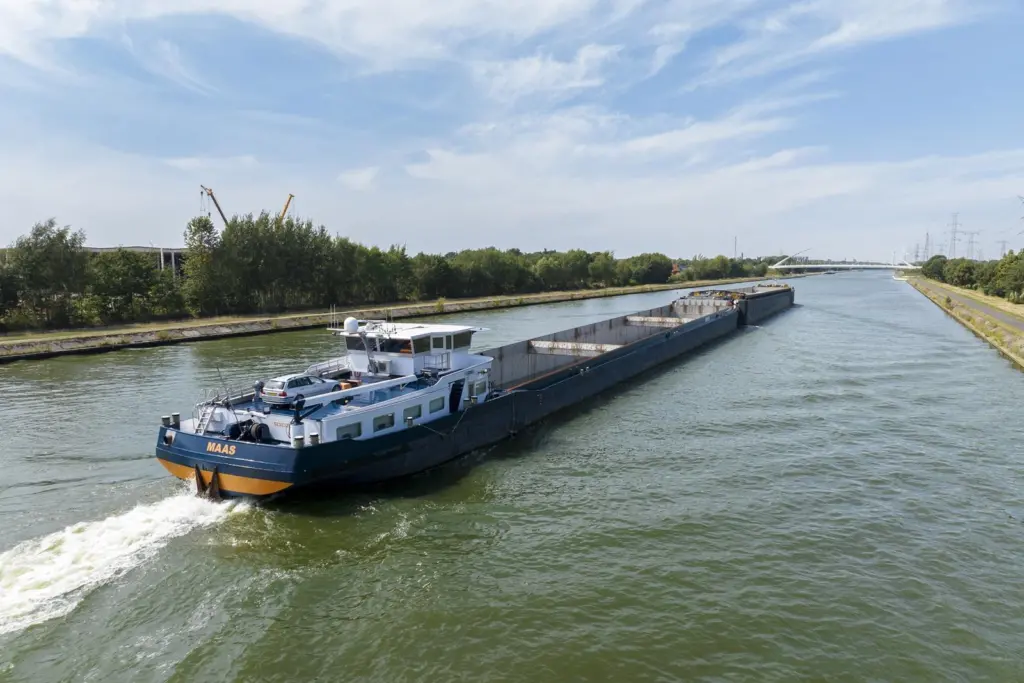
Future Proof Shipping’s inland vessel Maas has arrived at the yard in Werkendam and will now undergo a replacement of its internal combustion technology with hydrogen technology, removing both main engine and gearbox and installing a new modular propulsion system.
The new modular system will consist of electric motors, hydrogen tanks, a PEM fuel cell system and a battery system. They are separate units that can be removed for maintenance or replacement purposes.
Conversion project
The hydrogen and fuel cell system will be installed in the cargo space of the vessel, with the hydrogen being placed above the fuel cell system in two 40ft containers, approximately 1000kg at 300 bar.
Maas’s fuel cell system will be triple redundant with 825 kW capacity to supply propulsion and auxiliary power and a 504 kWh lithium-ion battery pack for peak shaving, secondary and bridging power. The system will contain a 750V DC bus bar and an e-motor for propulsion.
In addition to this landmark retrofit project, the yard has delivered a second fully electric ferry to Schlepp und Fährgesellschaft Kiel (SFK). The delivery follows the previous deliveries of three hybrid ferries and one fully electric ferry for the operator.
The Wellingdorf measures 24.7 by 7.2m and is a sister vessel of the previous delivered Düsternbrook.
It’s completely emission-free and entirely powered by battery power with an installed capacity of 1,092 kWh. Besides the battery pack the vessel has 20 solar panels on the roof to provide the onboard power supply network.
Where almost all ferries referred to as ‘fully electric’ still have back-up power provided by a diesel engine, Wellingdorf has no such backup and gets redundancies from the split battery system.
A noteworthy system on board is the non-conventional automated mooring system, which features electric-hydraulically operated mooring hooks in both sides of the ship. The mooring system is easily controlled from the wheelhouse by the captain. While moored, no power has to be directed to the propulsion system, resulting in a reduction in energy consumption.
SFK is renewing its current fleet in line with the environmental goals set by SFK and the city of Kiel. The city aims to be CO₂ neutral by 2050 and expects shipping to play a major part in this shift.