![MaritimeJournal[Seawork]](https://www.maritimejournal.com/wp-content/uploads/2026/09/MaritimeJournalSeawork.svg)





Solar panels installed to power Portsmouth
The installation of a ground-breaking solar and battery system at Portsmouth International Port has reached a major milestone with 2660 solar panels now installed.
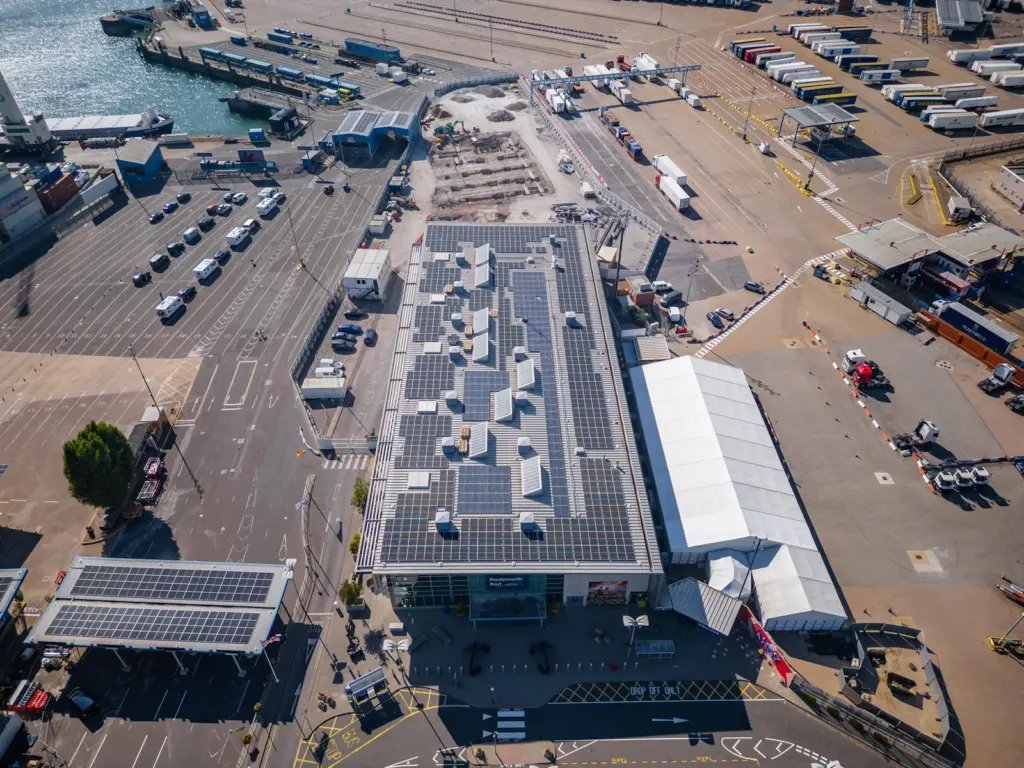
It’s a project which has broken new ground in the national context as it’s the first UK port to have solar canopies and will have a 1.2 mega-watt sized battery installed as part of a renewable installation.
“The port is owned by the people of Portsmouth, so we have an obligation to reduce the impact of our operations on the environment, whilst reaching the ambitions set out in our 20-year masterplan,” said Jerry Clarke, pilot and senior project manager at Portsmouth International Port.
“Combined with other sustainability initiatives, it will help us achieve our ambition of reaching net-zero carbon by 2030, and becoming one of the UK’s first zero emission ports by 2050.”
Breaking new ground
The project began in February 2022 and incorporates roof-mounted solar panels across a number of buildings, a large battery and solar canopies.
Power produced by the 2,660 solar panels will contribute around 35% of the site’s power; a significant step in the port’s ambition to be the UK’s first net zero carbon port.
It’s all part of an integrated approach that will also help the port offer shore power for smaller ships, without having to take extra power from the local electricity grid.
As well as generating carbon-free power, the solar canopies will provide shade for cars waiting to board ferries; allowing them to stay cooler for longer, without having to run their engines.
The battery, with a capacity of 1.5 megawatt hours (enough to run a typical home for four months), will capture green power that would otherwise be exported from the site, which can be used then used at the port when needed.
The new battery will work in tandem with a previously announced battery storage pilot, which will balance services to the national grid and storing power during lower pricing periods. When complete, it is estimated that in peak conditions 98% of the electricity consumed by the port will come from the solar and battery, combined.
The work is the latest in a series of solar and battery projects being managed by the council’s in-house energy services team.