![MaritimeJournal[Seawork]](https://www.maritimejournal.com/wp-content/uploads/2026/09/MaritimeJournalSeawork.svg)



Competition moves offshore wind into deeper waters
Seven new design ideas for offshore wind turbine foundations have been shortlisted by the UK’ s Carbon Trust in a competition aimed at transforming the offshore wind industry.
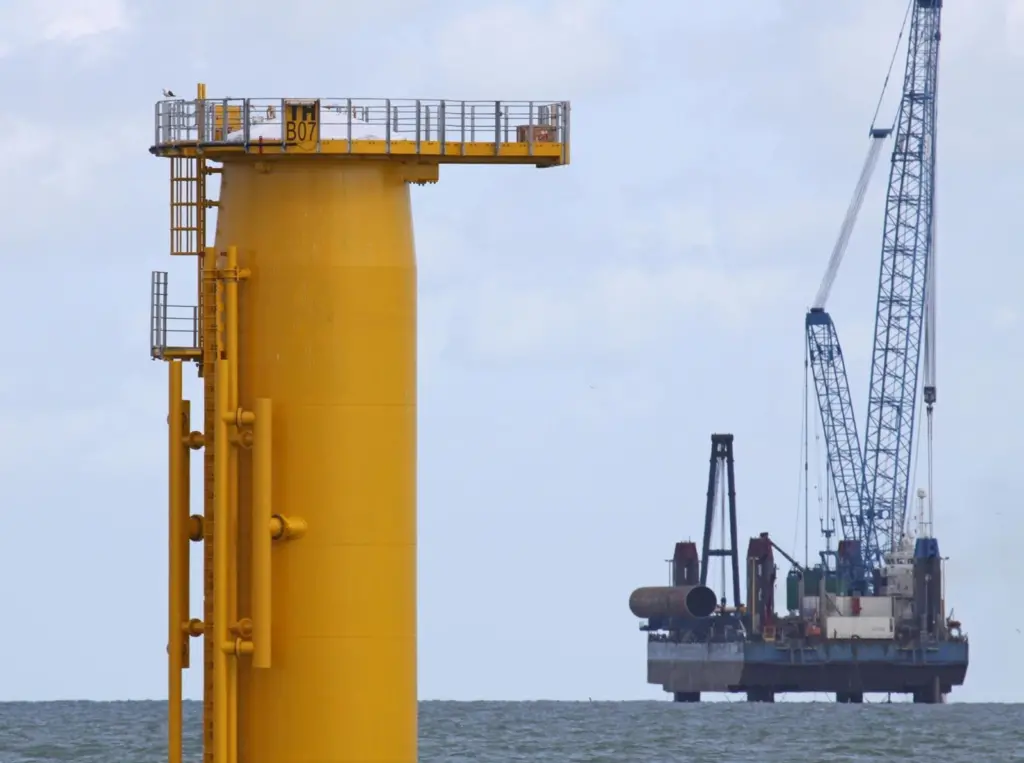
It comes at a time when the industry faces the challenge of controlling the costs of wind farms as they move into deeper waters in meeting the EU target of supplying 20% of its energy from renewable sources by 2020, a figure that will see an estimated 6,000 wind turbines in operation.
Offshore wind farms are an increasingly common sight off the UK coastline. The British Wind Energy Association reports that 600MW of the current 4GW of installed UK wind energy comes from offshore sources, most of which can be considered as inshore projects up to around 20km off the coast. Offshore wind energy is set to grow significantly as the industry matures. In the Thames Estuary alone five wind farms currently either operational or under development will provide around another 2100MW once fully commissioned.
The UK government’s planned Round 3 licensing allocation of sites is expected to result in the development of offshore wind farms up to 100 miles from the coast in water depths of around 60m. The engineering challenges and in particular controlling the costs of such projects (deepwater foundations account for 20% or more of a wind farm’s total project costs) will be essential for their success and hence the competition.
The Carbon Trust was formed by the UK government in 2001 to help companies and organisations reduce their carbon emissions and in April of this year launched the multi-million pound global competition aimed at producing innovative deepwater turbine foundation designs that address the technological challenges and in particular delivering a full lifecycle cost reduction of 30% over existing foundations for deeper water.
The shortlisted designs will each receive up to £100,000 towards concept development, engineering analysis, commercial feasibility and technical assistance with the final three winners gaining additional funding for building and installing large scale demonstration projects. The bigger prize however is the estimation of a potential £65 billion net economic value and 220,000 jobs in the UK by 2050 from offshore wind.
The applicants had to convince a formidable array of experts including the Carbon Trust’s partners: Airtricity Developments, DONG Energy, RWE Innogy owner of Npower Renewables, Scottish Power Renewables and Statoil. The submissions were judged on a wide range of criteria including manufacturing costs, transport and installation costs, potential for volume cost savings, structural design and durability, maintainability and turbine accessibility and decommissioning and removal costs.
Over 100 global engineering companies made submissions and the shortlisted entries were as follows: The UK/French consortium of Gifford, BMT and Freyssinet which proposed a large concrete gravity based structure, transported to the site by a submersible transport and installation barge. USA based Glosten Associates proposed a floating foundation based on Tension Leg Platform technology, comprising a buoyant hull, tendons and novel anchors. A Dutch/UK team from Suction Pile Technology and Wood Group proposed an asymmetric suction bucket tripod foundation transported to the site with the turbine already installed. US based Keystone Engineering proposed an inward battered guide structure comprising three supporting legs angled around a central pile in a twisted jacket approach. Another US company, Offshore Wind Power Systems of Europe, envisaged a platform floated into position with three legs lowered to the sea bed similar to a jack-up drilling rig. The Dutch Ballast Nedam group proposed a drilled concrete monopile and finally, Denmark’s MBD Offshore plans were for a suction bucket monopile manufactured primarily from steel using buoyant installation and delivery.
By Peter Barker
Related Articles
 ACCESSORIES & EQUIPMENT
 ACCESSORIES & EQUIPMENT
 MARINE CONSTRUCTION