![MaritimeJournal[Seawork]](https://www.maritimejournal.com/wp-content/uploads/2026/09/MaritimeJournalSeawork.svg)


Dredging underway for Tynes second tunnel
Work to dredge a channel across the UK’ s River Tyne to make way for the second vehicle tunnel started last weekend.
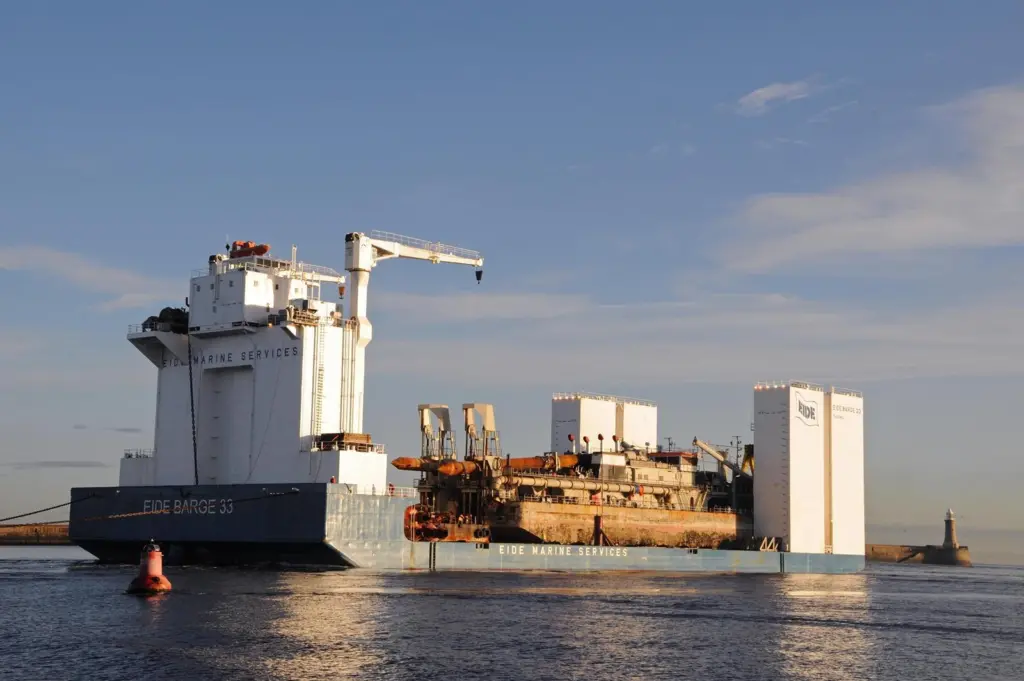
Jan De Nul’s 93.9m LOA medium sized stationary cutter suction dredger
Vesalius
reached the Tyne on Wednesday 4 November on board a semi-submersible barge operated by Norway’s Eide Marine Services AS and spent the rest of the week moored at Port of Tyne’s Riverside Quay in South Shields while preparing for dredging operations.
It was then moved into position in the southern half of the river, close to Jarrow’s Riverside Park on Sunday to commence dredging. The Vesalius will spend three weeks dredging the southern side of the river before relocating to dredge the northern half of the Tyne for three weeks.
Thanks to an innovative partnership arrangement developed between New Tyne Crossing design and build contractor, Bouygues Travaux Publics, and the Port of Tyne, dredging will be carried out using the cutter suction technique, with all spoil being pumped direct from the river bed via a 2.6 kilometre long pipeline into Tyne Dock, which is being infilled as part of the Port’s redevelopment plans.
Some 520,000 cubic meters of material excavated from the New Tyne Crossing site will be used to fill the Victorian Tyne Dock, with approximately 800,000 tons of material arising from dredging and the remaining 200,000 tons supplied from land excavations.
Nicolas Caille, project director for Bouygues Travaux Publics said, ‘We’re delighted to see work start on this vital part of the project. The land tunnels are well progressed, and the tunnel units that will be placed under the river have already been built at Walker dry dock. Once dredging is complete we can look forward to connecting Jarrow and East Howdon via the new vehicle tunnel.
‘We’re very pleased with the solution that’s been developed in partnership with the Port of Tyne. This approach brings so many benefits; for the environment, for local communities and for regeneration, that it brings a great sense of pride to see it underway.’
Andrew Moffat, CEO at the Port of Tyne added, ‘The Port of Tyne is committed to providing a vibrant and sustainable port right in to the next century. The infilling of Tyne Dock will create over 13 acres of additional land and will facilitate further development opportunities for the Port.’
Paul Fenwick, project director for New Tyne Crossing promoter, the Tyne and Wear Integrated Transport Authority, concluded, ‘The environmental benefits of this solution completely justify the transport authority’s case at Public Inquiry in 2003. We argued that flexibility was needed on the issue of waste disposal so that the concessionaire/contractor could explore the best environmental solution available once construction began, subject to necessary approvals by the relevant regulatory bodies. This position was accepted by the Inquiry Inspector, sanctioned by the Secretary of State and fully tested and endorsed by the High Court.
‘The use of dredged material to infill Tyne Dock, an option not available to us in 2003, shows the wisdom of this approach. We therefore welcome this solution as it will produce a better environmental alternative to landfill or disposal at sea.’
The four 90m long tunnel units currently stored at Walker dry dock will be lowered into the dredged trench early next year. The new vehicle tunnel will open to traffic in February 2011, at which point the existing tunnel will close to traffic for refurbishment. Both tunnels will be operational by the end of 2011.
Related Articles
 ACCESSORIES & EQUIPMENT
 ACCESSORIES & EQUIPMENT
 MARINE CONSTRUCTION