![MaritimeJournal[Seawork]](https://www.maritimejournal.com/wp-content/uploads/2026/09/MaritimeJournalSeawork.svg)




Elebia enhances autohook
Spain-based Elebia is upgrading its range of automatic hooks for the marine market, which keeps crane operators and those responsible for rigging at a safe distance.
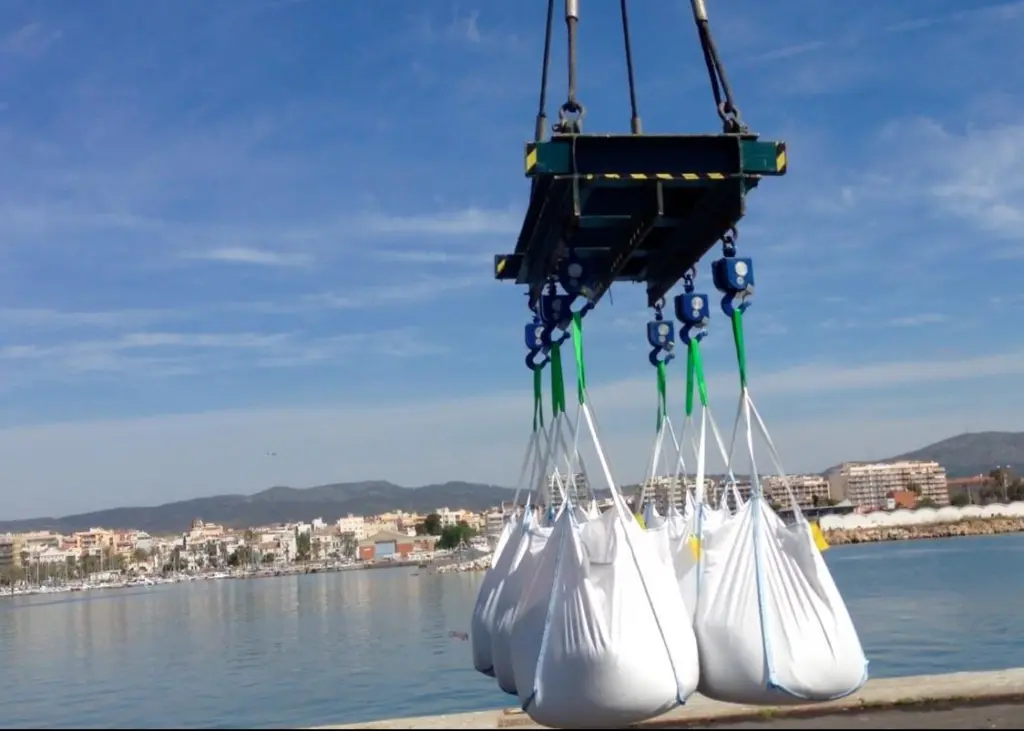
The patented Elebia hook features a magnet that both attracts and positions slings and other rigging gear. Now, the company says it’s enhanced safety and productivity with operational additions including a new remote control system called the eMax and a load cell.
Eight years ago, Elebia was awarded a patent for the product, which was introduced to the market two years later as a failsafe, 5 tonne capacity hook (the e5) that was able to remotely engage and release loads. In 2010, the e10 was launched before second generation versions followed (the evo5 and evo10) two years later and an evo20 was later unveiled.
“Our goal has always been to provide the most advanced and innovative crane hook in the world that enhances safety and productivity in lifting operations. Delivery of unprecedented safety and functionality to a variety of industries requires constant development of the entire product range,” said Oscar Fillol Vidal, CEO and founder, Elebia.
Elebia range includes rigging components and below-the-hook equipment that includes slings, bags, sleeves, load cells, remote controls and a heat shield.
The range also includes the eMini remote control that fits on a glove provided by Elebia, but its use is typically suited to the operation of a single unit. The hook features state-of-the-art electronics including a chargeable battery and radio communication. All events—open hook, close hook, overload alarm, unbalance alarm, temperature alarm, service warning, etc—are recorded and exported to a spreadsheet via a USB port.
“A load cell on a crane can provide information about the total load but not the load on each sling. Our automatic hooks with load cells and eMax technology can provide that integrated in a compact unit, while at the same time being able to remotely release and engage,” Mr Vidal added.
Research is already underway on a 100-tonne capacity hook, while ATEX and IECEx versions are currently awaiting certification.
By Rachael Doyle