![MaritimeJournal[Seawork]](https://www.maritimejournal.com/wp-content/uploads/2026/09/MaritimeJournalSeawork.svg)



First order for gas fuelled Environship
Rolls-Royce has received its first order for vessels based on the Group’s award winning, highly efficient, Environship concept.
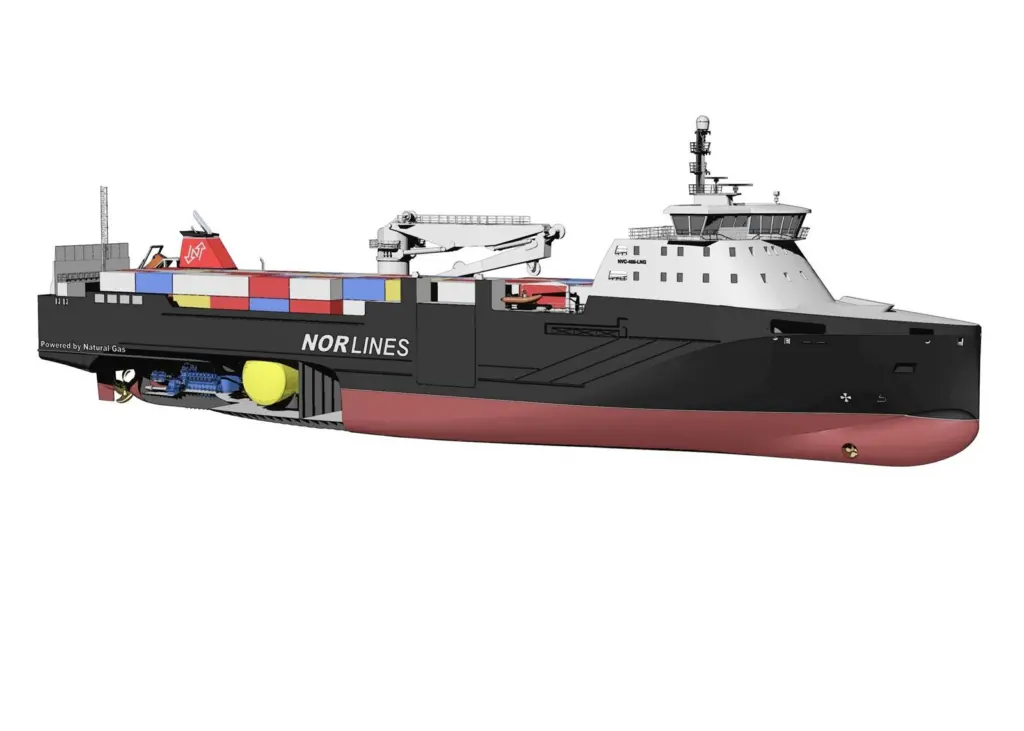
Rolls Royce will design and provide integrated power and propulsion systems for two technologically advanced cargo vessels, which have been purchased by Norwegian transportation company, Nor Lines AS.
These highly efficient ships incorporate a wave piercing bow, gas powered engines and an innovative Promas propulsion system, which combined, significantly improves the overall performance of the vessel, increasing fuel efficiency by up to 18%. It also provides numerous environmental benefits, including the virtual elimination of SOx and a reduction of CO2 emissions of more than 40% compared to similar conventional vessels.
The two Rolls-Royce NVC 405 cargo vessels will be built at the Tsuji Heavy Industries ship yard in Jiangsu, China and will enter service from October 2013, operating along the West Coast of Norway.
The contract is for two ships, and includes options to build an additional two vessels of the same design. Rolls-Royce is already using the Environship concept to develop a wide range of efficient ship designs, including passenger ferries, chemical tankers, gas tankers, bulk carriers, and superyachts.
The Rolls-Royce Environship concept received theNext Generation Ship Award at this year’s NorShipping event in Oslo, Norway.
Its Rolls-Royce Bergen B-Series lean burn gas engines emit around 17% less green house gases (CO2 minus methane slip) per unit of power than a diesel engine. The use of gas fuelled engines means that Nitrogen Oxide (NOx) emissions are reduced by about 90% while Sulphur Oxide (SOx) emissions are negligible. These emissions are already within the limits of IMO Tier III environmental legislation, due to come into force in 2016.
The Rolls-Royce Promas propulsion system is an integrated rudder and propeller, which alone improves efficiency of the vessel by 5 to 8%.
The new innovative bow shape and hull form, designed by Rolls-Royce, also reduce resistance by up to 8%, therefore reducing fuel burn and emissions further. The vertical bow shape enables the vessel to maintain speed even in rough seas, enabling operators to achieve demanding shipping schedules without the need to burn additional fuel to make up lost time.
Related Articles
 ACCESSORIES & EQUIPMENT
 ACCESSORIES & EQUIPMENT
 MARINE CONSTRUCTION