![MaritimeJournal[Seawork]](https://www.maritimejournal.com/wp-content/uploads/2026/09/MaritimeJournalSeawork.svg)


Increasing popularity for workboat decarbonisation webinar series
Over 500 delegates from across the globe virtually gathered on the 6th May to hear experts in commercial marine hybridisation and electrification talk about where these sectors are heading in the next decade.
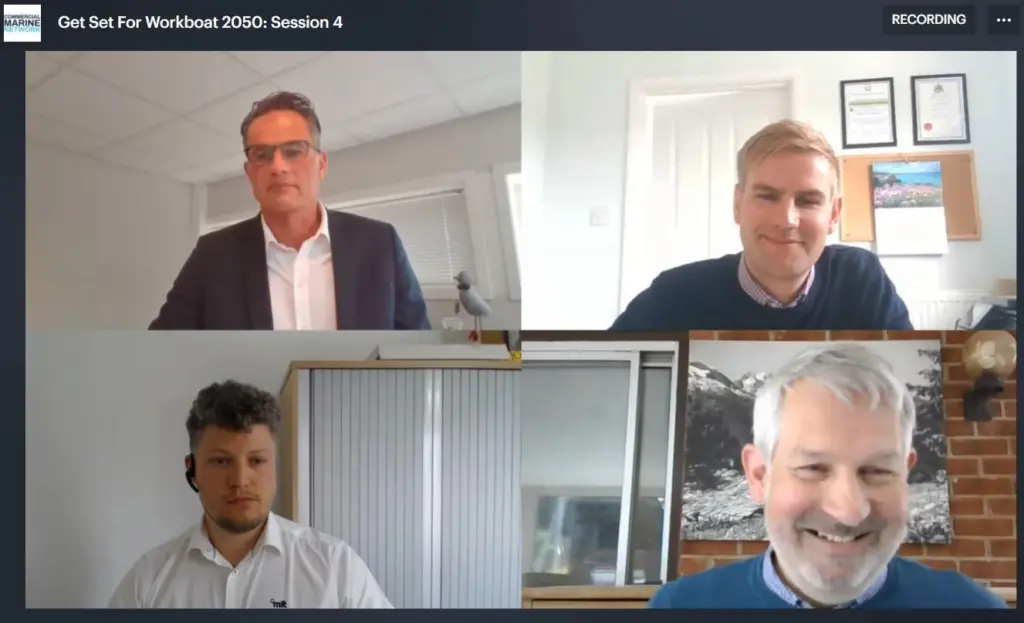
The webinar was brought to you by The Commercial Marine Network, Seawork and Maritime Journal, in association with The Workboat Association and kindly sponsored by Castoldi and supported by SMI, UKHMA, and UKMPA.
Tom Binns, Sales Manager at MIT, kicked off proceedings with some useful arguments for an integrated approach to electric and hybrid repowers and newbuilds. Data is key, and begins with taking a holistic view of the vessel, its operating cycle, future demands and loading profiles. But, as Tom explained, there is much more to it than the vessel, as charging requirements need to consider grid infrastructure, which in all countries, not least the UK, needs extensive further development.
MIT’s approach for an electric or hybrid repower looks at operating profile logs, such as one his presentation showed of a harbour tug. The company can then overlay its own information covering the efficiency ranges of the three systems it offers (Full electric, series hybrid, parallel hybrid), and use this to begin to inform choices. With enough information and analysis, MIT is getting close to the point where it can guarantee future vessel performance, even with the very latest technologies.
The ongoing cost of maintaining vessel uptime was a consideration that Tom says can sometimes get overlooked. Does the planned repower consider ease of future upgrades of battery, motor technologies? After all, the vessel lifespan is likely to be much longer than the propulsion technology lifespan.
‘REFUEL’ YOUR BATTERY
MSE International’s Simon Powell has been looking at various vessel decarbonisation options, and the UK-based marine innovation creation and facilitation concern has seen some excellent numbers coming in for the use of flow batteries in certain vessels.
As Simon explained, a flow battery uses a fluid electrolyte that can be replaced easily (pumped in), allowing the battery to be effectively ‘recharged’ much more quickly than current marine battery technologies such as lithium ion. Indeed, for a short leg, frequent stop ferry service, it’s plausible that the electrolyte could be replaced in the same time it takes to get vehicles and passengers on and off.
As always, there are downsides, such as energy density, which is currently about 50% of that offered by lithium ion. With that in mind, Simon predicts that the technology will not be used any time soon for planing, lightweight vessels, but MSE International has run a feasibility study on the Gosport ferry MV Harbour Spirit with very encouraging results. MSE’s next move on the project will be to get boats in the water for real world testing. How safe and feasible the flow battery concept will be in a moving vehicle is the next key area of research. As yet flow batteries have only been successfully used in static locations such as power stations. MSE has partnered with Lloyds Register to provide the necessary expert steering on the classification and safety side.
HIGH SPEED OPTIONS
Torlief Stokke, CEO of Servogear was on hand to dispel any myths that electrification and hybrid solutions were only for ferries and displacement plodders. Torlief is a great believer in optimising the most efficient propeller RPM to coincide with the most efficient electric motor RPM at the vessel’s cruising speed- a trick best achieved by inserting a reduction gearbox between the two.
With the right final drive system (propeller and reduction gearbox), Torlief has seen energy savings on electrified boats of up to 30%.
Torleif’s presentation offered some meaty case studies from HST’s electrified CTVs to a murdered dictator’s 90 foot Sunseeker now running at up to 35 knots on hydrogen. The latter’s only emission is water “fresh enough to mix in your drink”.
Don’t miss: Session 5: Long term 2035 onwards: The future fuel race – battery, hydrogen, ammonia etc. – How do we go about commissioning a vessel in this changing environment? This final event in the series is scheduled for 10:00 on 15th June. REGISTER HERE FOR SESSION 5
If you missed the session 4 presentations, you can access the video HERE
By Jake Frith