![MaritimeJournal[Seawork]](https://www.maritimejournal.com/wp-content/uploads/2026/09/MaritimeJournalSeawork.svg)



Met Office trials AutoNaut
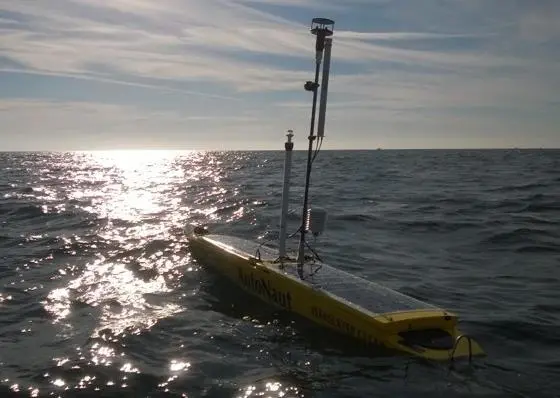
The unmanned surface vessel AutoNaut has completed a successful trial off Plymouth, UK carrying Meteorological Office sensors. In late November a suite of weather sensors provided by the UK’s Met Office put to sea aboard the 3.5m wave-propelled boat developed by Chichester based UK company MOST (Autonomous Vessels) Ltd. The aim was test the viability of collecting forecasting data in a new and more cost effective way.
Jon Turton, head of Marine Observations at the Met Office said: “From our perspective we are looking to assess whether an unmanned surface vehicle can be used to make reliable metocean measurements of the same quality as a moored weather buoy, and whether USVs could offer an alternative to operating moored buoys.”
AutoNaut has a unique wave propulsion system, which does not require fuel, and so is able to stay at sea for many months. Controlled via satellite, from anywhere in the world with an internet connection, she can carry a wide range of sensors.
In this case she carried the same sensors as the UK Met Office use on ocean buoys to provide data for weather forecasting. These include wind speed and direction, barometric pressure, humidity and temperature (both air and sea).
The trial took place over four days and nights on the Western Channel Observatory run by Plymouth Marine Laboratories where there are scientific buoys with the same sensors fitted. This will make possible a direct comparison between calibrated data from the buoys, and data gathered aboard the AutoNaut.
MOST (AV) had an AutoNaut out for 11 days in the same area last year. It carried a weather station on the mast, but not the same sensors as used by the Met Office, and the trial was not calibrated. The data was encouraging, but not scientifically comparable.
This time the sensors on the buoys were freshly calibrated by the Met Office, working with Plymouth Marine Laboratories, with the aim of providing a validated trial.
The trial aims to find out what are the differences in data provided by a moored buoy, and a small boat circling in the same area. One difference will be the height of the sensors. On buoys they may be 3m above the water. On the pre-production AutoNaut available for this trial they were 1.5m above the water. However, MOST says that AutoNaut is scalable, so it will not be difficult to build larger boats with 3m masts, if the results are positive.
A USV like AutoNaut could be preferable to a moored metocean buoy because buoys are expensive to moor and maintain with support ships, and in storms they sometimes break free. If AutoNaut can gather the same quality data, it will be possible to collect data for weather forecasting at reduced cost.
By Jake Frith