



Contractor/ Military Co-Operation Raises Lost Aircraft
Briggs Marine Contractors have played a key role in the recovery of an RAF aircraft which crashed into the River Humber near the town of Brough in Yorkshire UK.
Both pilots had ejected safely from the Tornado GR4 before it crashed at half-tide, entering the water at speed, fragmenting and embedding itself in the sandy river bottom.
The British Ministry of Defence (MoD) Salvage and Marine Operations Team (North) conducted a site survey which determined that strong tidal currents made the use of recovery divers impossible. Specialist equipment would be required to carry out recovery operations.
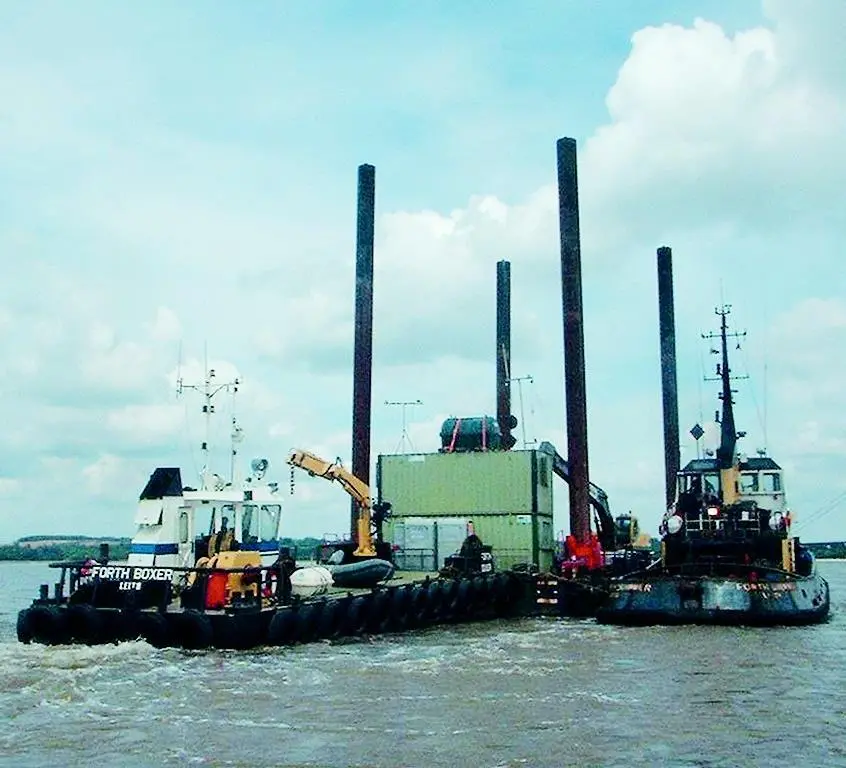
Briggs was awarded the contract to supply and operate a spudleg barge/jackup capable of housing an excavator fitted with a riddle bucket attachment, a wreckage wash-down holding area and offices to be used by the MoD. The spudleg barge Clark Avon , the multicat Forth Boxer and the tug Forth Drummer were mobilised to the site.
Under the operational control of the MoD project officer and with full co-operation and support from Briggs’ project leader Brian Banks, the Clark Avon was positioned over the areas where wreckage was believed to lie. The use of a sophisticated navigational system on board the Clark Avon and the Fort Boxer’s ability to manoeuvre with precision enabled accurate positioning.
Recovery work was synchronised with the tides and the Clark Avon was manned on a 24 hour basis, providing security for both the facilities and the wreckage.
The tide restricted recovery operations to three hour periods before and after low water.
Over 34 days, an area of approximately 75 x 50m was searched and wreckage recovered.
Recovered wreckage was washed to remove sand and mud and stored for transfer ashore into RAF custody. The excavator swept an arc of 200º at an outreach of 15m, moving to 38 new sites during the recovery period.
Despite the conditions and expectations to the contrary, close co-operation between Briggs and the MoD saw the operation recover the vast majority of the wreckage, which is now proving invaluable to the ongoing RAF investigation of the accident.
MJ Information No: 17507
Related Articles
 ACCESSORIES & EQUIPMENT
 MARINE CONSTRUCTION
 POWER & PROPULSION