![MaritimeJournal[Seawork]](https://www.maritimejournal.com/wp-content/uploads/2026/09/MaritimeJournalSeawork.svg)




New lightweight ferry boasts all-round benefits
A new lightweight, double ended ferry just delivered to the Port of Copenhagen boasts particularly low CO2 emission levels and fuel savings of up to 50 %, according to its builders.
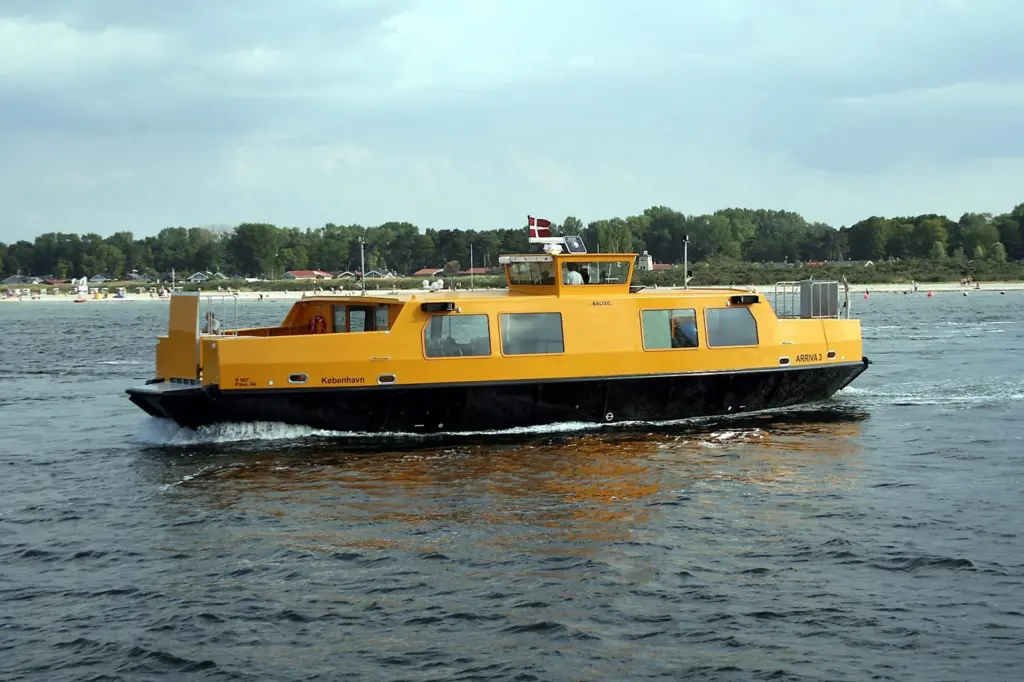
The 22.9m long and 6.8m wide
Arriva 3
was planned and built for operation in the Port of Copenhagen inside the surprisingly short time of six months at the
in Luebeck by yard chief Stefan Schultz and engineer Tina Kohn.
The Type B220DE monohull ferry is the first of its kind from the small German facility but Tina Kohn told MJ that follow-up orders were possible and under discussion. Word was that two more ships might be involved. Kohn said ‘further ships are needed as part of the expansion of ferry services’ in the Danish port.
‘We are particularly proud of this ferry, she added, ‘because we realised the project with our suppliers inside just six months and that included both planning and construction’. She said the owners wanted the ship for ferry traffic over short distances within the port and on inland waterways.
Arriva 3 draws 1.1 m and displaces 34 tons fully laden. It carries 84 passengers and a crew of two. The fore and aft engine and rudder systems are comprise of two 102 kW Type D5A-TA four-stroke Volvo Penta diesels, two ZF 220 vertical offset marine transmission systems and two Schottel SRP 50/50 rudder propellers, providing a maximum speed of 9 knots. The vessel also boasts two Sleipner SP285 sidepower bow thrusters.
The ferry is of glass-epoxy composite panel construction (GRP) which Tina Kohn said enabled the required performance to be achieved with smaller engines while the ship remained strong, robust, easy to handle and very manoeuvrable.
Baltic added that ‘a dramatic reduction in fuel consumption’ of as much as 50% was possible as a result while ‘the tough epoxy surface keeps regular maintenance costs low’.
By Tom Todd
Related Articles
 ACCESSORIES & EQUIPMENT
 ACCESSORIES & EQUIPMENT
 MARINE CONSTRUCTION