![MaritimeJournal[Seawork]](https://www.maritimejournal.com/wp-content/uploads/2026/09/MaritimeJournalSeawork.svg)



Painstaking recovery from crane drama
It must have been the kind of moment every contractor dreads: the smaller of two cranes started to tip sideways during a tandem lift, the pontoon underneath began to list dangerously and within moments the 187 tonne load and both cranes lay in the rubble of six buildings.
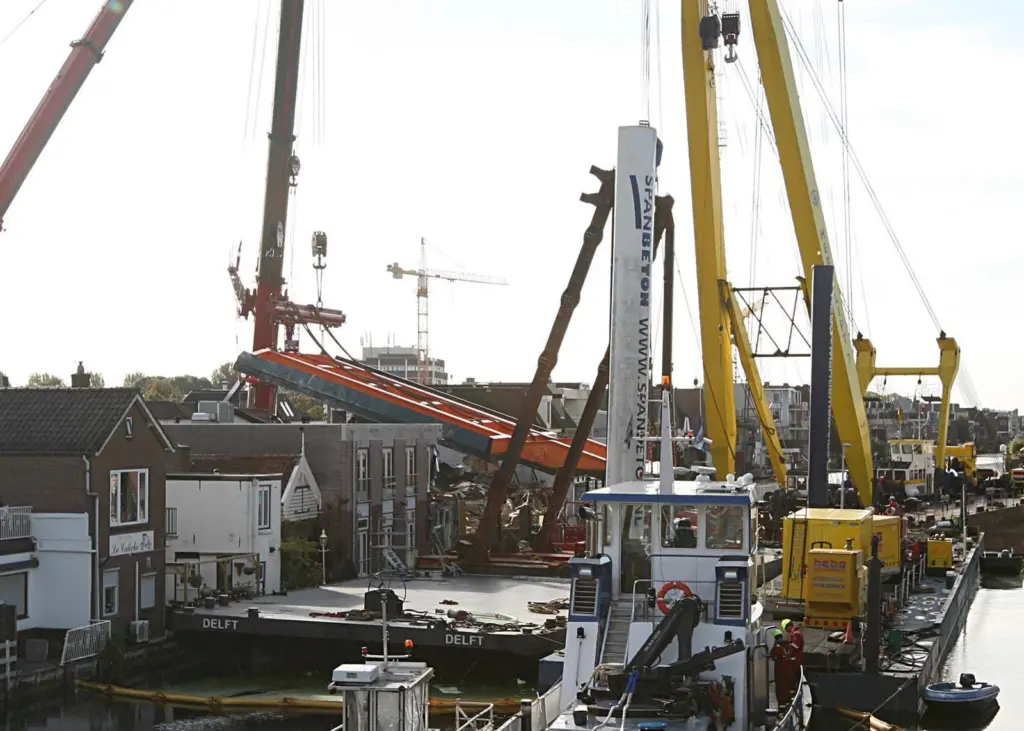
At first it was feared that 20 people could have been injured during the 3 August accident on the Queen Juliana Bridge restoration project: it’s a miracle that only a dog was killed.
However, helping to clear the devastation in the Dutch town of Alphen aan der Rijn has been a delicate operation for Mammoet-Hebo. The first phase was stabilising the scene so that investigators could gain access.
After that, the salvors were faced with the delicate task of removing the damaged bridge section and the pair of cranes from the tangle of wreckage without further undermining the buildings. “There was some fear” that the move could result in more damage, town council spokesperson Saskia Brandt told MJ, especially as a number of the buildings along the Hoofstraat (the affected thoroughfare) have compromised structural integrity. Moreover, these tandem lifts were obviously shadowed by the worry caused by the first accident and the salvors had to work under the eagle eye of residents, “which is something they are not used to”, added Ms Brandt.
So, operations had to be precisely executed. First came the removal of the larger, Terex crane’s 700 tonne boom, accomplished by Mammoet from the road behind the waterway. It was lifted directly upward, swung over what remained of the buildings and placed on the waiting barge. Next the somewhat lighter LTM1400 crane boom was lifted away from its resting point on top of the bridge section before being carried out on the next barge.
After the departure of the other two vessels, the last barge moved in to receive the ill-fated bridge section itself: this has been taken away for investigation and will be thoroughly tested although whether restoration is possible has not yet been determined said Ms Brandt.
The financial impact will be sizeable, 14 local homes had to be evacuated, four businesses closed and a section of the Rijn took around six weeks to reopen: “In the first week of the accident we estimated our costs to be at least €1.3 million. We don’t know what the final costs will be,” admitted Ms Brandt.
Apportioning responsibility between main contractor Mourik, subcontractors BSB Staalbouw and Peinemann has yet to be decided by investigators and insurers. However, some tough questions are being asked about the use of two different capacity mobile cranes in a tandem lift, a difficult manoeuvre which might have stressed the barge’s stability along with the smaller crane’s capacity.
By Stevie Knight