![MaritimeJournal[Seawork]](https://www.maritimejournal.com/wp-content/uploads/2026/09/MaritimeJournalSeawork.svg)






Ping is the thing at Ocean Business
Among the many products being given on the water demonstrations at the well attended Ocean Business 2009 exhibition and conference in Southampton UK this week is what claims to be the world’ s first fully integrated high resolution real time 3D sonar inspection system.
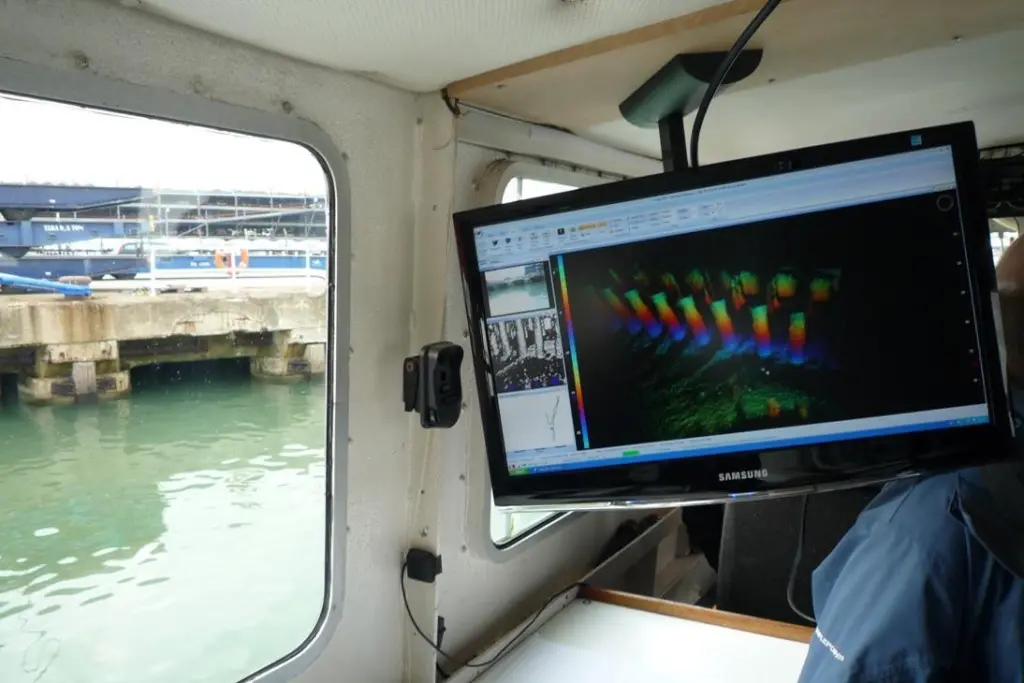
Sailing from the National Oceanography Centre on board ‘Wessex Explorer’, interested delegates were impressed with the versatility and performance of the Coda Echoscope system, which is ideal for use in navigationally restricted waters such as those behind the exhibition site.
The Coda Echoscope-UIS (Underwater Inspection System) is built on knowledge gained in a collaborative development with the Center for Ocean Technology at the University of South Florida, with funding from the US Office of Naval Research (ONR) and the US Coast Guard, whose interests would extend to port and harbour security. The system can be programmed to record and store detail of an underwater environment then pinpoint any differences which may be found in a subsequent inspection.
Echoscope has also been specifically designed and developed to work as a Construction Monitoring System (CMS). The software enables operators to clearly visualise, monitor and place objects such as concrete armour protection blocks underwater in real time. The intuitive software will provide 3D graphic representation of the block and automatic tracking of its position and orientation. One of the first customers for the new system is a joint venture of Dutch dredging and marine construction contractors Van Oord and Boskalis.
The compact and portable Coda Echoscope is about the size of a briefcase and can be rapidly deployed on vessels of opportunity. It can be used on almost any vessel with an over the side or bow mounting and can also be mounted on ROVs or AUVs.
With over 16,000 simultaneous beams, it can acquire all the data required for an inspection task from a single ping. This removes the need to co-register the data using survey positioning and motion sensing equipment and can therefore be operated without specialist survey knowledge. The large overlap between areas covered by each ping allows high vessel speeds whilst maintaining 100% coverage.
The addition of motion sensor inputs enables the data to be positioned accurately in 3D space and adjacent pings can be used to create mosaics online. The resulting whole area visualisation allows for extremely rapid reconnaissance and inspection.
Related Articles
 ACCESSORIES & EQUIPMENT
 ACCESSORIES & EQUIPMENT
 MARINE CONSTRUCTION