![MaritimeJournal[Seawork]](https://www.maritimejournal.com/wp-content/uploads/2026/09/MaritimeJournalSeawork.svg)




RNLI checking the Chinese
A technical team from the Royal National Lifeboat Institution in Poole have recently returned from a trip to China where they reported on the condition of the fleet of ex-RNLI lifeboats now operating in the country.
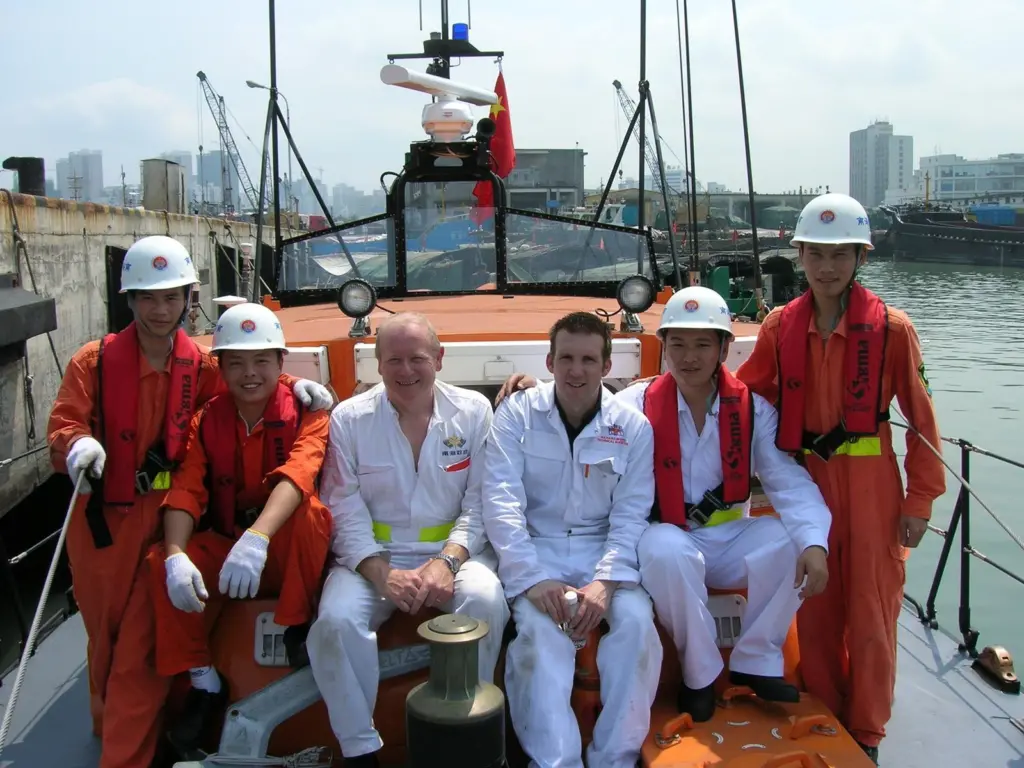
As reported in Maritime Journal (June 2008) the Chinese Ministry of Transport’s Rescue and Salvage Bureau have entered into an agreement with the RNLI to help them develop their fledgling rescue service following a conference of the International Maritime Rescue Federation at Cape Town in 2003. The CRSB fleet mainly comprises deep-sea salvage tugs and the expansion of their search and rescue capabilities involved a requirement for smaller shallow draught craft. It was here that the RNLI became involved by providing a supply of lifeboats that, while becoming surplus to their own requirements were still very capable rescue craft thanks to the RNLI’s high levels of built quality and maintenance standards. The package also included training both in China and at the RNLI Lifeboat College at Poole for the crews who were to operate the lifeboats. So far eight Tyne class and ten Arun class all weather lifeboats together with two Atlantic 21 inshore lifeboats have been shipped to China and the arrangement also includes ongoing checking of the lifeboats’ condition, technical support, maintenance and operational capability taking the form of inspections, feedback and recommendations. David Page (RNLI Divisional Engineer / South) and Richard Morris (RNLI Technical Surveyor) have now completed the latest review of the fleet.
The team visited 10 bases along China’s east coast, Shenzhen, Guangzhou, Zhanjiang, Haikou, Xiamen, Ningbo, Taicang, Rongcheng, Tianjin and Qinhuangdao. The checking of each lifeboat involved a formal meeting, an inspection of the lifeboat and a sea trip to check the boat’s functionality and the crew’s competence.
Unlike their RNLI counterparts whose crews are made up largely of volunteers, the China Rescue and Salvage Bureau crews are full time seafarers mainly drawn from the larger tugs and salvage vessels. One interesting aspect of the CRSB approach to maintaining the boats is that as each base has a full dive team, underwater inspections and the cleaning of the hulls is carried out by the divers rather than hauling the boats out of the water in the more conventional way. The team were generally supportive of this but made it clear that diver inspection alone was not sufficient to maintain the operational effectiveness of the lifeboats.
Following the round of inspections a final meeting was held at the CRSB headquarters in Beijing where the reports were presented to the organisation’s director general, Captain Song and other senior officials. The team from the RNLI gave a general thumbs up to the state of the lifeboats, finding them generally much improved since the last inspection.
The RNLI team were accompanied by Richard Morris’ wife, Wenyan Zhou, who worked as interpreter during the trip, particularly useful at the technical level. Over 3,000 miles were covered during the trip and the RNLI’s involvement, bringing their vast experience of lifeboat operations to this expanding part of the country’s maritime rescue service is greatly valued by the Chinese, who are dedicated to making lifeboats in China a success.
Related Articles
 ACCESSORIES & EQUIPMENT
 ACCESSORIES & EQUIPMENT
 MARINE CONSTRUCTION