![MaritimeJournal[Seawork]](https://www.maritimejournal.com/wp-content/uploads/2026/09/MaritimeJournalSeawork.svg)





SAR frequencies change to be implemented
The UK’ s Maritime and Coastguard Agency has issued a reminder to seafarers of important changes to the operating frequencies of the Cospas-Sarsat satellite based distress alerting service.
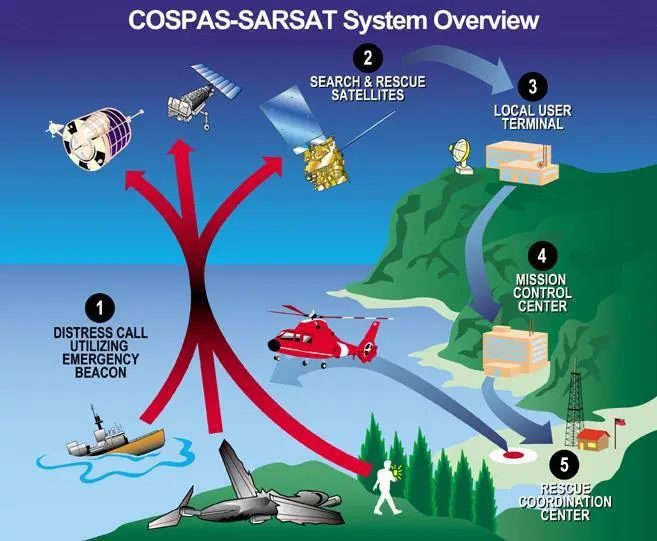
From 1 February 2009 the system will cease processing the 121.5/243 MHz signals and switch over to the more reliable and versatile 406 MHz system.Mariners are being urged to check their on board equipment to ensure that they have the correct versions fitted. The changes affect maritime beacons that rely on satellite detection, including EPIRBS, aviation beacons (ELTs), and personal beacons (PLBs). Equipment that operates on the 121.5 MHz system but does not rely on satellite detection such as man overboard systems and homing transmitters are unaffected by the changes and can continue to be used. Also unaffected is the Royal National Lifeboat Institution’s MOB Guardian confidential fishing vessel position reporting system, which uses the Iridium satellite network system.
The mandating of the relevant safety requirements for ships and aircraft are the responsibility of two United Nations organisations, the International Civil Aviation Organisation (ICAO) and the International Maritime Organisation (IMO), which together recognised the limitations of the 121.5/243 MHz system. After guidance was issued to the Cospas-Sarsat organisation it was decided to cease the processing of satellite information using these analogue frequencies and rely instead on the superior qualities of the 406 MHz digital alerting system.
Cospas-Sarsat was formed in 1979 by the former USSR, USA, Canada and France and their first successful rescue mission was in 1982 when three people were rescued after their light aircraft crashed in Canada. Since then the system has been instrumental in the saving of over 22,000 lives worldwide. The service is based around a network of geostationary and low altitude earth orbit satellites. Alerts from vessels in distress are relayed through the satellites to a chain of earth stations, including the relevant rescue coordination centres, which then initiate the appropriate response. Around a million beacons of both types are registered worldwide
The improved service provided by the 406 MHz system includes the ability to store beacon identification data, an increase in signal power (5 watts instead of 0.1watts), global as opposed to regional coverage, and 100m positional accuracy (with GPS input) rather than 20km previously. The 45 minute alert time of the analogue system, requiring two satellite passes, is improved to 5 minutes with just one satellite pass with the digital system.
The previous incidence of false alarms has been a cause of concern, with only one in 50 alerts being a genuine distress. With the 406MHz system this has been considerably reduced to one in 17. A quick telephone call to the beacon’s registered owner can often determine the authenticity of the alert and it is therefore crucial that the information stored on the organisation’s registration database is up to date. The registration data for UK EPIRBs is held by Falmouth Coastguard and further information on the Cospas-Sarsat system, including links to the beacon registration website, can be found at www.cospas-sarsat.org
Steve Huxley, MCA Search and Rescue Communications Manager said, ‘The digital 406 MHz beacons offer many advantages over analogue 121.5/243 MHz beacons. With a 406 MHz beacon, the position of the distress can be relayed to rescue services around the world more quickly, more reliably and with greater accuracy. When a 406 MHz beacon signal is received, SAR authorities can retrieve information from a registration database. This includes beacon owner contact information, emergency contact information, and vessel/aircraft identifying characteristics. Having this information allows SAR services to respond appropriately. Make sure your 406 MHz beacon is properly and accurately registered.’
By Peter Barker
Related Articles
 ACCESSORIES & EQUIPMENT
 ACCESSORIES & EQUIPMENT
 MARINE CONSTRUCTION