![MaritimeJournal[Seawork]](https://www.maritimejournal.com/wp-content/uploads/2026/09/MaritimeJournalSeawork.svg)


Georgia plans new deep-water port
Georgias Ministry of Economy and Sustainable Development has announced that the Anaklia Development Consortium has been awarded the contract to build and develop a new deep sea port close to the town of Anaklia on Georgias Black Sea coast.
This project is planned as part of a new trade route between China and Europe that will resurrect the old Silk Road route and create what is claimed to be the fastest transit time between the two regions.
The Anaklia Development Consortium is a joint venture between TBC Holding LLC based in Georgia, and Conti International LLC, a US developer of infrastructure and capital projects. Kurt Conti, who is the CEO and president of Conti International, commented, “We are delighted and honoured to be awarded this contract to undertake the infrastructure development of Anaklia’s Deep Sea Port and we are looking forward to breaking ground and working with the government of
Georgia to help forge new paths from Asia to Europe as well as unlocking the economic potential of Georgia’s neighbours and the landlocked nations in the Caucasus”
The Anaklia Deep Sea Port will cover approximately 400 hectares of land, and the consortium will have exclusive rights to use the land for 49 years. The location, a few miles south of the existing town was selected because it there is a deep water approach channel that comes close to the shore in this location. This is expected to minimise the need for dredging in the port approaches and it will provide deep-sea accessibility for ships up to post-Panamax size. On completion the port will have the capacity to handle up to 100m tonnes of cargo per year.
The government of Georgia, which initiated the project, has committed to invest $100m in ensuring its success. Construction on the project is scheduled to begin by the end of 2016, subject to the completion of environmental reviews. The European Commission has predicted that a modernisation of the shipping services at Anaklia will save the EU’s economy up to €10 billion by 2030 and reduce associated port costs by almost 7%.
The project itself is expected to create as many as 3,400 jobs during the construction stage and 6,400 jobs to operate the port upon completion. Mamuka Khazaradze, the founder and president of TBC Holding and also founder and chairman of TBC Bank JSC, said, “The Anaklia project represents a one-of-a-kind investment in the restoration of the Silk Road that will pay dividends for generations of workers in Asia and Europe. The government of Georgia deserves much credit for its foresight in initiating this project and ensuring it receives the support necessary for its completion. Their level of commitment clearly reflects the port’s tremendous economic importance to the country and the region.”
ADC is a special purpose vehicle between TBC holding and CONTI international. Its role is to manage all works related to the tender for the Anaklia deep sea port and now that the contract has been awarded, ADC’s team will take part in raising capital, planning, and managing the construction of the port.
Both of the shareholder companies have extensive relations with international companies. TBC Holding has been developing projects in Georgia since 1992, partnering with various international financial institutions. Conti International is US-based construction and development company that has been in business since 1906 and has a presence internationally.
The project is going to be divided into nine phases and the total cost will be $2.5 billion.
By the end of the final phase, the port will have a capacity of 100 million tonnes. A large part of the project will be the free industrial zone that will be managed along with the port. The first phase is to begin in July 2016 and end in 2019. The rest of the timeline will be dictated by the market with and all phases should be implemented by 2030.
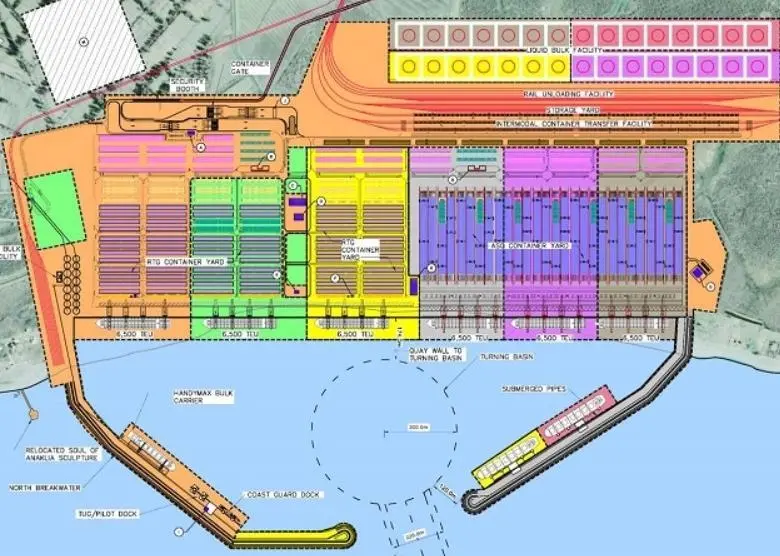
One of the project partners is Moffatt & Nichol, one of the world’s leading port design companies. The initial plans envisage two breakwater arms extending out from the shore to enclose the main dock basin. Along the shore side of the basin there will be berths for up to 6 container ships with an extensive container holding area linked directly to a rail transit station. Along the northern breakwater arm there will be a bulk cargo handling area complete with rail links plus facilities for the port tugs and ancillary vessels. The southern breakwater arm with have facilities for liquid cargoes which will be linked to a liquid bulk storage facility in the port area.
At their seaward end the two breakwaters will terminate just a short distance from the deep water canyon located offshore and the dredged channel will link this deep water to the port. It is anticipated that the port will offer a depth of 16 metres alongside the container berths.
By Dag Pike