![MaritimeJournal[Seawork]](https://www.maritimejournal.com/wp-content/uploads/2026/09/MaritimeJournalSeawork.svg)






$billions needed for offshore substations: Report
A recent report has predicted spending on offshore substations for offshore wind could amount to more than $20 billion (€18.6 billion) this decade – and this is just for the substations.
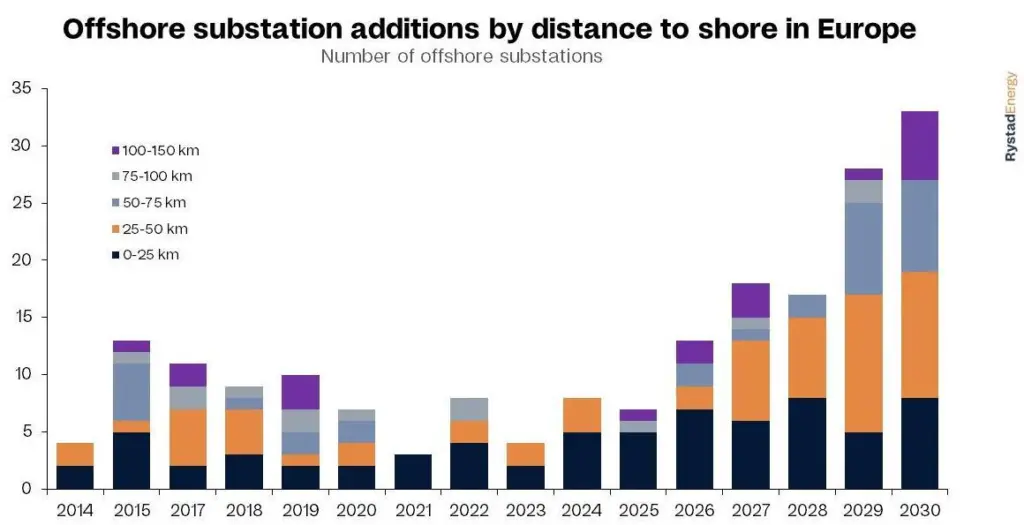
Norwegian research and consultancy Rystad Energy says 137 substations will be installed offshore Europe by 2030, requiring this amount of investment, with annual spending shooting up eight-fold from the current average of $1.4 billion a year to $8.4 billion.
The surge is because of the scale of offshore wind projects and their increasing distances from shore, Rystad says, with projects exceeding 1GW of capacity needing several substations rather than just one.
“Offshore substations are particularly beneficial for projects over 200 megawatts in capacity and located more than 15 kilometres from shore, as they help minimize power transmission losses,” Rystad says. “They are also valuable for other energy initiatives, such as electrifying offshore oil and gas production platforms.
“Europe is set to install eight new offshore substations in 2024 alone, double last year’s number. This year, new offshore substations will be confined to wind projects located within 50km of the coast. However, in the latter half of this decade we expect a notable uptick in offshore wind installations beyond the 50km mark, driving more need for offshore substations.”
Senior offshore wind analyst Petra Manuel says demand will grow even more when floating wind technology takes off because they can be placed even further from shore.
However despite fears over a shortage of installation vessels, she said heavy-lift vessels were not in such short supply as they were usually capable of insatalling large offshore foundations and the components of offshore substations.
“We are not seeing a significant bottleneck in this type of vessel, especially because the amount of offshore substations to be installed is not as large as the number of wind turbines,” she said. “In terms of manufacturing capacity, China holds the lion’s share (60%) of the global supply capacity of monopiles, while Europe holds about a third of the global supply capacity.”
Related Articles
 INDUSTRY NEWS
 MARINE CIVILS
 MARINE CIVILS