![MaritimeJournal[Seawork]](https://www.maritimejournal.com/wp-content/uploads/2026/09/MaritimeJournalSeawork.svg)



EU Ports Strategy does not go far enough: WindEurope
As Brussels lays out an ambitious vision for ports as Europe’s energy hubs, the wind industry is warning that without dedicated public finance, the infrastructure bottlenecks threatening the offshore wind build-out will not be solved.
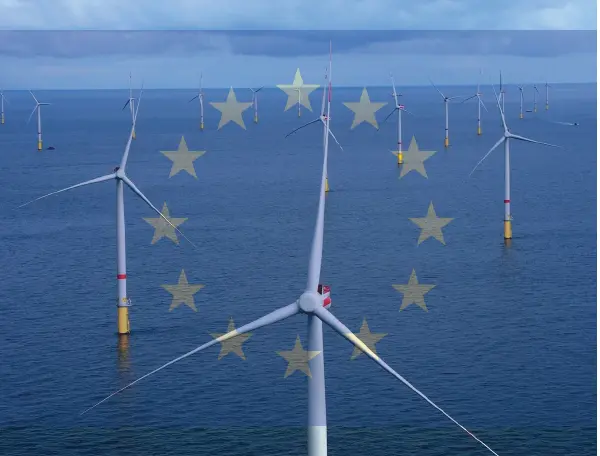
Europe’s ports have long been the workhorses of global trade, but they are now being asked to perform an altogether different task: anchoring the continent’s energy transition.
A new EU Ports Strategy, published by the European Commission on 4 March 2026, recognises ports as critical infrastructure for offshore wind, hydrogen and electrification, not just commerce.
But almost immediately after the strategy was published, the European trade association WindEurope said while it was a step forward, it wasn’t enough.
Stakeholders in the renewables sector are saying the escalations of Middle East tensions and resulting oil and gas price surges have served as a pointer towards increasing the amount of wind and solar in Europe to avoid future situations.
“Offshore wind is among Europe’s best bets to reduce its dangerous exposure to expensive and volatile fossil fuel imports,” says WindEurope. “Last year alone, Europe invested €22.5 bn in new offshore wind. Europe has 39GW of offshore wind capacity, rising to 73GW by 2030.”
Delivering that expansion at pace demands a supply chain that can keep up, and ports sit at the heart of it, they say.
A vision for multi-functional hubs
The Commission’s strategy positions ports as the nodal points of integrated energy systems, linking offshore grids, cross-border interconnectors and cable landfalls.
Reinforced quays, deeper berths, expanded storage areas and improved grid connections are all identified as essential upgrades, particularly as turbine components continue to grow in size and weight.
With floating offshore wind on the horizon, ports are also expected to evolve into assembly, storage and deployment hubs for an entirely new generation of structures.
To unlock the necessary investment, the Commission points to streamlined permitting, better coordination of funding instruments and clearer project pipelines. Resilience is also a priority: the strategy calls for ports to be hardened against climate impacts, cyber threats and geopolitical disruption.
The overall message to the marine infrastructure sector is that Europe must ramp up its port construction and upgrade works to help drive this energy transition.
The funding gap WindEurope says Brussels must close
WindEurope says the €2.1 billion investment gap is an urgent shortfall, and while it acknowledges the Commission’s call for faster permitting and grid infrastructure building, it says these measures will not be sufficient without dedicated funding to back them up.
Between 2021 and 2024, ports received close to €90 million under the Connecting Europe Facility (CEF). WindEurope welcomes the larger CEF Transport budget due in the next cycle, but warns that investment in offshore wind-related port infrastructure is still not clearly listed as a main priority.
It also criticises the Commission’s suggestion that private investment should take the lead. Europe will only attract private capital, WindEurope argues, if public de-risking instruments are put in place first.
Vessels, shipyards and supply chain
The Commission’s Ports Strategy was published alongside a complementary EU Maritime Industrial Strategy, which targets the shipbuilding sector.
Rather than direct financial incentives, that document aims to level the playing field with non-European yards by monitoring distortive trade practices from overseas competitors. It also proposes a coordinated pipeline of public orders to stabilise demand for European shipyards, combined with faster permitting for upgrade works.
For the offshore wind industry, the maritime strategy’s focus on protecting European vessel manufacturing takes a targeted approach, concentrating on high-value segments where European industrial potential is already strong: offshore support vessels and cable-laying vessels, both of which are already produced on the continent.
A new Industrial Maritime Value Chain Alliance is to be established to identify further business cases across the European maritime sector.
Recent successful multi-gigawatt offshore wind auctions in Poland and the UK have injected fresh confidence into the European market, WindEurope says, while the North Sea Summit in Hamburg produced a landmark Investment Pact committing North Seas countries to two-sided Contracts for Difference for 10GW of offshore wind a year between 2031 and 2040.
“They further pledged to removing regulatory obstacles to Power Purchase Agreements (PPAs),” says WindEurope. “In exchange, Europe’s wind industry committed to mobilising €1 trillion of economic activity for Europe, creating 91,000 additional jobs and investing €9.5bn in the value chain, including manufacturing, port infrastructure and vessels.”
Almost every wind turbine component passes through a port. As turbines grow ever larger and floating wind moves from pilot to commercial scale, port infrastructure must scale accordingly or the pipeline of projects stalls at the quayside.
Related Articles
 INDUSTRY NEWS
 MARINE CIVILS
 MARINE CIVILS