![MaritimeJournal[Seawork]](https://www.maritimejournal.com/wp-content/uploads/2026/09/MaritimeJournalSeawork.svg)


Greener dredging solution for any port in a storm
Adverse weather events cause a lot of disruption around the world, not only to buildings and assets, but to livelihoods and vital transport links.
During storms, ports are considered to be “safe havens”, where the water is calmer and more protected from external weather conditions. However, this also means that this is where sediment naturally settles, and this can further disrupt infrastructure networks.
As a result, ports, harbours, rivers and reservoirs need to manage the impact of storm events, and therefore need to dredge more often and on a more random basis – as opposed to planned campaigns – to keep traffic moving and supply chains healthy.
Accretion of sediment on river and sea beds can often lead to an imbalanced build-up of materials, making bodies of water unnavigable. This can also have a detrimental impact on wildlife, habitats and the wider environment if it is not carefully and efficiently managed.
The most effective method to address this problem is dredging, but it can come at a huge cost – both from a resource and financial perspective.
Traditional methods of dredging can be useful in these situations, though there are limitations, particularly when it comes to needing to dredge with short notice and at various locations around the globe.
Flexibility, cost and emissions
Moving dredgers around the world in response to the demand naturally increases costs and can be a lengthy process. Specialist vessels may in particular be in short supply, being shared among sites and organisations.
Depending on where the incident has occurred and its scale, it can be the difference between being able to mobilise the required team and tools and having to plan to execute in a number of days or weeks. This, in turn, can be the difference between keeping traffic moving and the economy thriving, or having to come up with an alternative site or solution that causes costly delays, both for the operator and the general public.
As with most services, asking for something with a level of urgency often comes with a price tag to match. And, due to the nature of the request, being able to mobilise resources and ensure the feasibility of vital transport links and infrastructure means we likely pay a premium for this privilege.
The cost of increased levels of dredging impacts not only the bottom line, but also our environment.
Commissioning substantial workboats for additional campaigns puts a heavy load on the environment, in the form of increased greenhouse gas emissions, noise pollution and marine disruption under the water, among other things.
Where traditional methods are being deployed, such as TSHDs (trailing suction hopper dredgers), this equates to a much higher cost for the campaign, with the need for them to travel to Disposal Sites to offload the collected materials, often travelling up to 20 miles offshore – which can take hours – after just one hour of dredging.
Unfortunately, this also means that Disposal Sites will fill up more quickly and become unusable for the planned campaigns, which happen as part of the core dredging calendar each year.
The opportunity
Jake Storey, Executive Director of Haven Dredging and CFO of Harwich Haven Authority, says the company has answered these problems with its Tiamat hydrodynamic dredging solution, which was developed to reduce dredging impact and increase the flexibility of the work it carries out – and in doing so, it says, at least £1 million is saved per campaign.
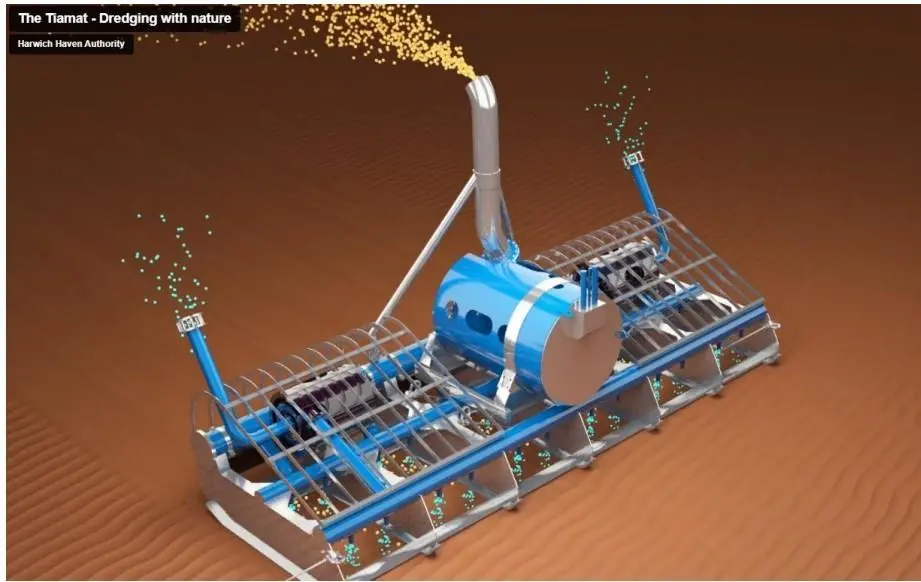
The technology is a frame that carries three pumps, two for injecting water into the sediment overlying the harbour bed, the other for extracting the diluted silt and pumping it up a 6m tall pipe, from where it is released into the water column.
The frame is mounted on the winch of a small workboat and lowered into the water to the required depth – and being able to use a standard, small vessel that does not have to be adapted or modified resolves some of the capacity and resource constraints that can exist in dredging.
The silt is then washed out of the harbour in the natural tidal currents – which Haven Dredging calls ‘dredging with nature’ – where the power of the tide and sea and river currents is used, instead of using the dredger to create a density current.
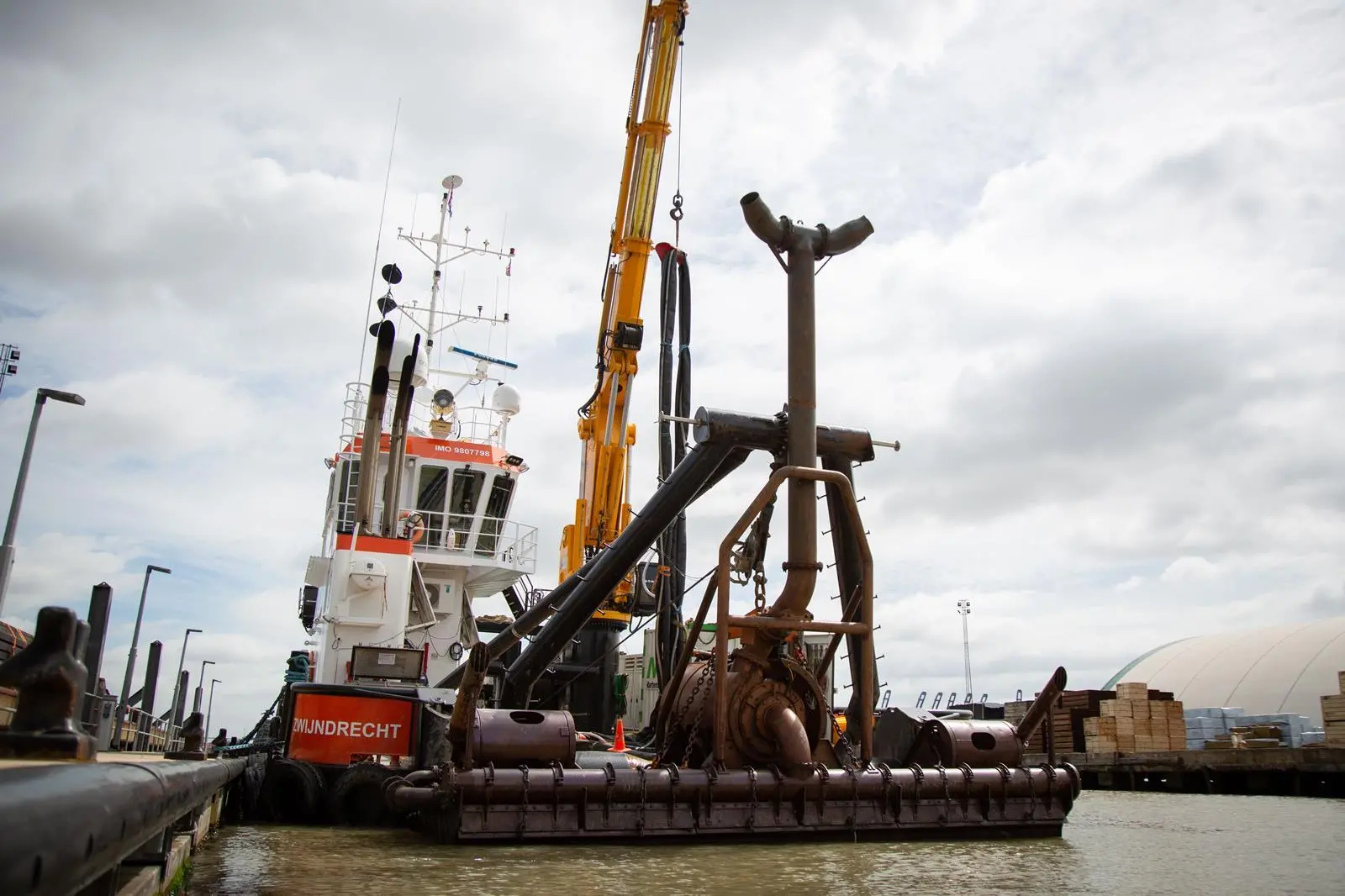
Tiamat promotes self-replenishment in the estuarian system, says Haven, through the natural re-suspension of sediment, then placing it back into the water column at the appropriate depth.
Tiamat was initially trialled in Harwich and has now been in practice for more than 18 months, replacing three TSHD campaigns with three Tiamat campaigns a year, each saving the Harwich Haven Authority at least £1 million per campaign.
Its non-invasive practices have helped to cut emissions by up to 90% at Harwich Haven, the company says, and in an ever-changing climate where dredging is probably going to be needed more and more often, this can only be a good thing.
Related Articles
 INDUSTRY NEWS
 MARINE CIVILS
 MARINE CIVILS